







Common Sense Media Review
 By Joly Herman
,
based on child development research. How do we rate?
By Joly Herman
,
based on child development research. How do we rate?
Bilingual adventures teach problem-solving and curiosity.
Parents Need to Know
Why Age 3+?
Any Positive Content?
Where to Watch
Videos and Photos


Dora the Explorer
Parent and Kid Reviews
Based on 71 parent reviews
Parents say the show is a valuable tool for teaching young children Spanish and promoting positive values like cooperation and problem-solving, making it particularly appealing for kids aged 2-5. However, many adults find the repetitive nature and loud interaction annoying, and some express concerns over the show's portrayal of adventure themes and exaggerated characters, indicating mixed feelings about its long-term educational value.
- bilingual education
- positive role models
- repetitive format
- engaging for toddlers
- mixed adult opinions
 Summarized with AI
Based on 187 kid reviews
What's the Story?
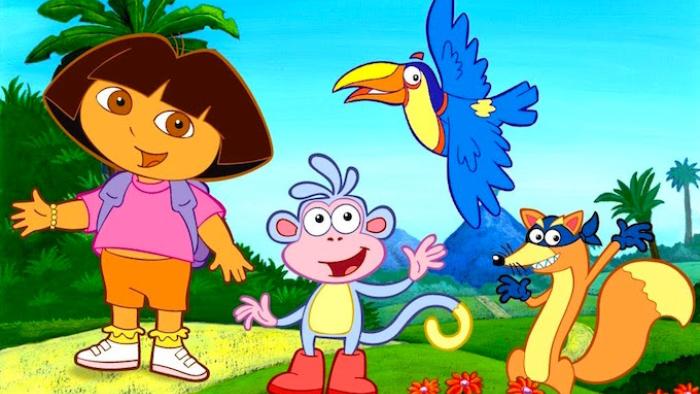
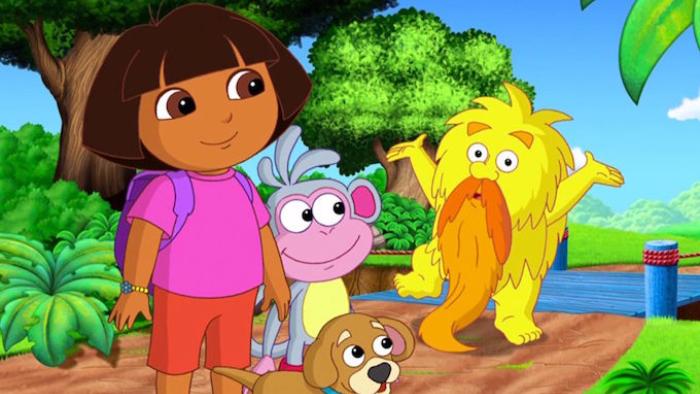
DORA THE EXPLORER is about young Dora (voiced by Kathleen Herles, Fátima Ptacek, and Caitlin Sanchez) and her companion, a monkey named Boots (Harrison Chad, Regan Mizrahi, and Koda Gursoy), who are always on the go. They travel over rivers and mountains to reach whatever goal has been set for a particular episode. Dora gets help from her trusty talking Backpack (Sasha Toro, Alexandria Suarez, and Sofia Lopez) full of necessary items and her Map (Marc Weiner), which illustrates the obstacles between Dora and her goal. When Dora reaches her destination, she and Boots break out in song and dance, exclaiming "We did it, we did it!"
Is It Any Good?
On one hand, Dora is an admirable character with a can-do attitude, but on the other hand, the show can seem simplistic––even for young viewers. Challenges in Dora the Explorer are often similar, which may get a bit monotonous. Still, the bilingual and cultural aspects of the series are on target, featuring music, holidays, and plants and animals from various Latin American countries. And Dora often decides to "stop and think" about a problem when she can't immediately solve it, demonstrating thoughtfulness and patience—qualities you might want your preschooler to mimic.
Talk to Your Kids About ...
Families can talk about Dora the Explorer's repeating words, tasks, songs, and interactive content. Do you think the repetition helps kids with learning and participation? What have you learned from Dora and her friends?
What do you think of the show's bilingual format and cultural themes? Do they inspire kids to learn second languages and multiculturalism?
What good qualities make Dora a positive influence for young viewers? And are there any aspects of her adventures that parents might want to discuss or clarify?
How do Dora and her friends demonstrate communication, curiosity, and perseverance? Why are these important character strengths?
TV Details
- Premiere date : August 14, 2000
- Cast : Caitlin Sanchez , Harrison Chad , Kathleen Herles , Marc Weiner
- Network : Nickelodeon
- Genre : Kids' Animation
- Topics : Adventures , Animals ( Wild Animals ) , Arts ( Music and Sing-Along ) , Friendship , Numbers and Letters
- Character Strengths : Communication , Curiosity , Perseverance
- TV rating :
- Awards : Common Sense Media Award , Emmy - Emmy Award Winner , Emmy - Emmy Award Nominee , NAACP Image Award - NAACP Image Award Winner , NAACP Image Award - NAACP Image Award Nominee
- Last updated : August 16, 2026
Did we miss something on diversity?
Research shows a connection between kids' healthy self-esteem and positive portrayals in media. That's why we've added a new "Diverse Representations" section to our reviews that will be rolling out on an ongoing basis. You can help us help kids by
Suggest an Update
Common Sense Media's unbiased ratings are created by expert reviewers and aren't influenced by the product's creators or by any of our funders, affiliates, or partners.
See how we rate