



Parents' Guide to Kids' First Trip to the Movies
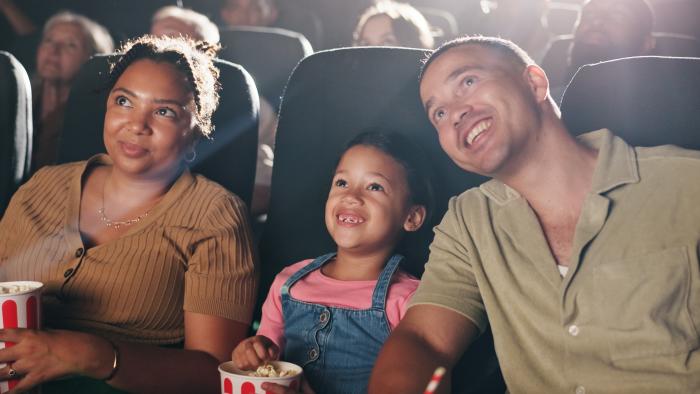
Lots of children see their first movie in the theater around the age of 3 or 4, though some parents wait until kids are a bit older, especially if they're sensitive to loud noises or scared of the dark. Either way, when you have young kids, there's more to deciding to go to the movies than just checking the schedule and heading to the multiplex. Taking them to the theater can be a fun, exciting family experience, but it requires some thought and planning, especially the first time you go. With kid-friendly movies like Paw Patrol: The Dino Movie, Minions & Monsters, and Moana in theaters this summer, here are some tips for making that first theatrical adventure a success:
Before you go
- Lay the groundwork: If your kids haven't watched feature-length movies before, try a couple at home before you head to the theater to make sure they have the attention span for a full film. (We have some great suggestions to start with!) And while you might prefer to avoid spoilers yourself, kids often do well if they have a sense of how the story is going to play out ahead of time—watch trailers, see if there are any tie-in picture books available, or look for a summary online.
- Hype it up: Proving that you really can find just about anything on YouTube, there are several "first trip to the theater" videos (like this one) available to give kids a sense of what to expect.
- Do a little homework: Check reviews (like ours!) before you go so you know what to expect in terms of content and can be ready to manage your kids' reaction.
- Choose wisely: Consider picking a familiar favorite for your kid's first time at the movies. Some theaters show classic kids' movies on the big screen for special engagements or during school breaks, and if your kid already knows how things will turn out, they might be able to relax and enjoy the experience a bit more.
- Set expectations: Explain theater etiquette (no talking, no devices, no getting up to walk around, etc.) to help normalize what it means to enjoy movies in public spaces with other people. Kids need to know that it's not the same as being at home in your living room or watching with friends.
- Plan it out: Get to the theater early so that you have time to hit the bathroom, grab snacks, find a booster seat if needed, and be settled in your seats without rushing. And be strategic about the time of day you go—early matinees are often great when it comes to young kids' stamina (plus, they're usually less expensive). Some theater chains, like Alamo Drafthouse, even have specific "kid friendly" screenings where behavior expectations are a little less strict (and it might not be as dark or as loud), which can make things less stressful.
While you're there
- Manage the volume: Many kids don't realize how much louder it can be to see a movie in the theater vs. at home. Have earplugs or headphones at the ready.
- Be polite: Everyone in the theater wants to enjoy the movie, so remind kids not to talk (or, if they have to say something, to whisper), not to make a mess with their snacks, and, if they're sitting in a seat with buttons, not to play with them.
- Get snacks: Let's be honest: Half the fun of going to the theater is getting popcorn or candy to munch on while you watch. Snacks can also give kids something to do or a reason to sit still.
- Choose your seats strategically: Many theaters now let you choose your seats ahead of time, so you and your kids can pick where you'd like to sit before you go. Give them a say in the matter, but remember that it's often a good idea to sit a bit further back from the screen and near an exit/on an aisle (in case you need to pop out for a bathroom break or a quick breather—see below). Bonus: If your seats have adjustable armrests, you might be able to raise the one between you and your kid.
- Take breaks if you need to: If things get a little too intense at any point, it's totally OK to take breaks. Leaving the theater to sit in the lobby for a minute doesn't mean your outing is over—sometimes a quick moment of calm will be enough to prepare a kid for one more try. And, if not, rest assured that you won't be the first parent who's left a theater with an overwhelmed kid. It's frustrating when you've spent money on tickets, but you don't want to force your kid to sit through something they're not ready for.
After the credits roll
- Talk about it: Once you've left the theater, check in with your kid about the experience. What did they like? Not like? What would they want to do differently next time? You can also talk about the movie itself—we offer suggested discussion questions on all of our movie reviews that can be a great place to start. (For example: Did you find any parts of the movie scary? Which ones? Why? Or, which characters did you think were doing the right thing? Why?)

Betsy's experiences working in online parenting and entertainment content were the perfect preparation for her role as Common Sense's editorial director. After earning bachelor's and master's degrees from Northwestern University's Medill School of Journalism in, as her kids say, "the late 1900s," she began her editorial career at BabyCenter.com and then served as an editor at Reel.com, Emode.com, AOL's Digital City, and Netflix before joining Common Sense Media in 2006. She's a lifelong movie and TV fan (a few favorites include The Princess Bride, Saturday Night Live, and Star Wars) and is delighted to have a job that makes keeping up on celebrity and pop culture news a necessity—which, in turn, helps give her (a little) cred with her two kids.
In her role at Common Sense, Betsy has had the privilege of moderating a Comic-Con panel, serving as a juror for the San Francisco Film Festival, touring the set of Imagination Movers, interviewing filmmakers like The Good Dinosaur's Peter Sohn, and much more. She is also a member of the Alliance of Women Film Journalists and The Impact Guild.
Recommended reads on this topic