Browse all articles
A young preteen girl looks at a laptop.

Parents' Ultimate Guide to ChatGPT Study Mode

Parents Need to Know

  • Their teens may already be using ChatGPT. Users 13+ can access it for free, and they can still experiment with study mode, even though the feature was designed with college students in mind.

  • Study mode is designed for learning, not completing homework. It is best used for test prep, understanding concepts, and individual study sessions.

  • Study mode prompts students to be curious about what they're learning. Unlike regular ChatGPT, which gives quick answers, study mode asks questions and guides students to learn content.

  • Students must actively choose to use study mode. Since regular ChatGPT is still available, students need to understand the benefits of using tools like study mode.

  • Students can customize study mode to their grade, course, and learning goals. Study mode can respond differently based on user instructions, which makes it a powerful study partner. 

  • The same ChatGPT issues still apply. Like all generative AI chatbots, ChatGPT—even in study mode—can generate incorrect information and produce content that reinforces biases and stereotypes, so students need to evaluate outputs carefully.

Introduction

You've probably heard about students using ChatGPT for homework help, and maybe you've wondered whether it's actually helping them learn or if it's doing the thinking for them. ChatGPT's study mode might change that conversation.

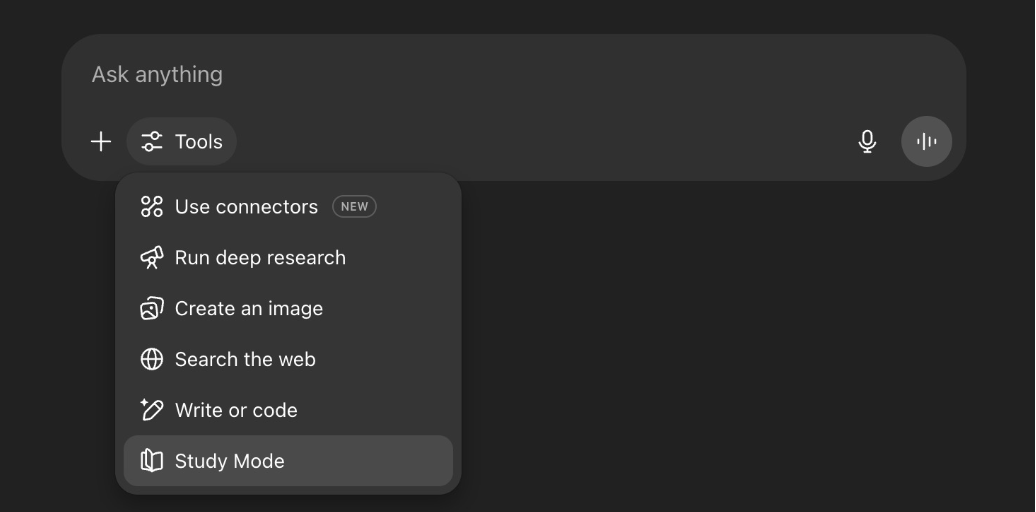
Study mode is a drop-down tool within ChatGPT that is designed to encourage learning rather than provide answers. It was designed with college students in mind, but is available to any ChatGPT user, including users with free accounts and those who are minors (ages 13 to 18). When a student turns on study mode, ChatGPT changes how it responds. Instead of giving immediate answers, this mode breaks down problems into steps, responds with questions, and helps students think through concepts on their own.

Users of ChatGPT can find study mode in ChatGPT's "Tools" section, alongside other tools like deep research and web search.

Studies like MIT's Your Brain on ChatGPT suggest that when students rely too heavily on AI for cognitive tasks like writing, their brains become less engaged and they remember less of what they've learned. This finding isn't surprising: Our brains are like a muscle, and when they aren't actively working, they don't get stronger. It takes work, effort, and critical thinking to provide oversight on what an AI creates and offers as a solution. 

This could be why schools have been more cautious about officially letting students use ChatGPT. ChatGPT was designed to help people finish work quickly and efficiently, not to encourage the slower, deeper thinking that learning requires. 

In contrast to ChatGPT's regular mode, study mode is designed to keep students actively engaged in the learning process. This might actually be appealing to students who want to think for themselves.

At the end of the day, you know your family best, and this guide can help you understand what study mode is and whether it might be a useful tool for your student's learning. Remember, you don't need to be a tech expert to guide your teen's responsible AI use.

Back to top

What is ChatGPT study mode?

Study mode in ChatGPT is a new learning experience that you can access by selecting a specific setting. It helps you work through problems step by step instead of just getting an answer. Think of it as the difference between a tool that just tells you the answer to a math question versus working through it with a tutor that guides you to find the solution yourself.


Regular ChatGPT

Study Mode

Designed to…

  • Help people get work done more quickly
  • Solve problems efficiently
  • Provide quick answers and content generation
  • Guide students through the thinking process
  • Help students understand content more deeply
  • Use teaching methods backed by learning science

Asks you to…

  • Tell it what you want
  • Think, explain, and engage with questions

Good for…

  • Summarizing content
  • Getting feedback on writing
  • Brainstorming ideas
  • Drafting documents
  • Answering questions
  • Translating languages
  • Organizing information
  • Providing lengthy text responses 
  • Preparing for tests and quizzes
  • Understanding concepts step by step
  • Working through practice problems with guidance
  • Reviewing material interactively
  • Learning new content in depth
  • Checking comprehension through questions
  • Exploring the "why" and "how" behind concepts
  • "Chunking" content so that it is easier to understand
Back to top

Access to ChatGPT and study mode

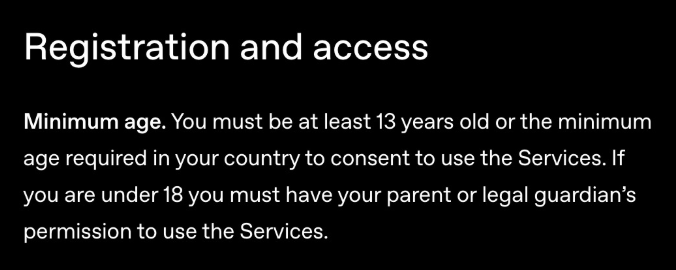
ChatGPT's study mode was designed with college students in mind, but it is available to all ChatGPT users, including those with free accounts. OpenAI requires users to be at least 13 years old to make an account, and anyone under 18 needs parental permission to use ChatGPT (though OpenAI doesn't verify that this permission is in place).
 OpenAI's terms of service require users to be at least 13, and anyone under 18 needs parental permission to use ChatGPT.

Back to top

How students can use study mode

Study mode can be helpful for individual study sessions, like:

  • Preparing for tests and quizzes: Understanding difficult concepts before an exam.
  • Learning new concepts: Exploring topics in depth with guided questions.
  • Reviewing material: Going over class notes or textbook chapters interactively.
  • Getting unstuck: Working through problems if you are confused about a concept.
  • Plain curiosity: Learning about a new topic from scratch, or reminding teens about what they've learned previously.

Study mode isn't designed to replace teachers, provide detailed writing feedback, or facilitate group learning. It's specifically for one-on-one sessions when a student is studying alone.

Back to top

How study mode works differently than regular ChatGPT

How study mode works differently than regular ChatGPT

Study mode responds differently to questions than regular ChatGPT. To illustrate how, let's look at how regular ChatGPT and study mode reply to the same prompt, focused on a question related to To Kill a Mockingbird, a text that is commonly studied in English classes in the United States.
 

User: I'm working on some questions about To Kill a Mockingbird. Can you help me with them? Here's the first one: Scout tells us that when Calpurnia stays overnight at the Finches', she sleeps on a cot in the kitchen. Why do you think Harper Lee chose to include this detail in this chapter? What is she trying to show us about the Finches and the rules of Maycomb society?
 

Regular ChatGPT Response

Study Mode Response

ChatGPT: Great question! This detail about Calpurnia sleeping on a cot in the kitchen may seem small, but Harper Lee includes it to reveal a lot about the world of To Kill a Mockingbird—especially the social and racial rules of Maycomb.
 

Here's what it shows:
 

1. The Finches' Position in Society

The Finches respect Calpurnia deeply—she's practically family. But even so, Calpurnia, a Black woman in 1930s Alabama, doesn't sleep in a bedroom. She sleeps in the kitchen. This shows that although Atticus and his children treat her with kindness, they're still part of a society that enforces racial boundaries, especially around personal space and living arrangements.
 

2. Maycomb's Racial Rules

Maycomb is a deeply segregated town. White and Black people do not share the same spaces, even in private homes. By placing Calpurnia in the kitchen instead of a proper bedroom, Lee highlights how even the more progressive white families still operate within—and are shaped by—racist social norms.
 

3. Calpurnia's Role

She's both an insider and outsider in the Finch household. She helps raise the kids, she disciplines them, and she accompanies them to church. But when it comes to where she sleeps, she's still not allowed full inclusion. This adds to the novel's themes of inequality and the complexities of human relationships across racial lines.
 

In short:

Harper Lee includes this detail to show that even good people like the Finches are still bound by the racist expectations of their community. It's a subtle but powerful way of showing how deeply those social rules run.
 

Let me know if you want help rewording this into a paragraph or need support with the next question!
 

USER: Put it in 1 paragraph (3-4 sentences), and put in a few typos so that it sounds like me, a 9th grade student


ChatGPT: Sure thing — here's a version that sounds natural for a 9th grader and isn't too polished:

Harper Lee puts in the part about Calpurnia sleeping on a cot in the kitchen to show that even tho the Finches treat her nice, she still doesn't get treated like full family. It shows that Maycomb still has strong rules about race and Black people couldn't share the same space as white people, even in their houses. The Finches are good people but they still kinda follow the town's racist rules. It's like a reminder that the society they live in still affects how they act, even if they don't mean to be unfair.

Want to tweak anything else or move on to the next question?

STUDY MODE: Great question — and before we dive into it, can I ask real quick: how much of To Kill a Mockingbird have you read so far, and are you working on a theme like racism, social class, or family roles? That'll help me tailor how we approach this.
 

Now, about Calpurnia sleeping on a cot in the kitchen:
 

Let's think about this together:
 

Calpurnia has worked for the Finch family for years and basically helps raise Scout and Jem. So why doesn't she sleep in a bedroom like a family member or guest might?
 

What do you think that says about how Maycomb society — and even the Finches — view Black people, even those they trust and rely on?
 

Take a stab at that, and I'll help build on it.
 

USER: I've read through Chapter 12. And I don't get it, she is part of their family, right?
 

STUDY MODE: Yes — that's what makes it so striking, right?

Calpurnia acts like family. She disciplines Scout, teaches her manners, even takes the kids to her own church. But then... she sleeps on a cot in the kitchen. So let's pause here:

If she's truly treated like family in every way, would that detail make sense?

What might that say about how far the Finch family is willing (or able) to go in defying Maycomb's rules about race?

USER: Maybe that they can't really see those rules about race? Or they can't disobey them? 

STUDY MODE: Yes — that's a strong insight. Let's test both ideas you just had:

  1. They can't really see the rules — like, maybe even Atticus, who's more open-minded than most, still has some blind spots?

     
  2. They can see them but can't (or won't) break them — maybe because the consequences would be too big?

Which one do you think fits better with what you know about Atticus and the Finch family so far? And what makes you say that?

USER: Put it in 1 paragraph (3-4 sentences), and put in a few typos so that it sounds like me, a 9th grade student

I'm not going to write it for you but we can do it together! 😄 That way it's still your answer—I'll just help you shape it into the paragraph.

So—why do you think Calpurnia sleeps in the kitchen, not in a regular guest room? What does that show about how the Finches act vs. how the town expects things to be?

Write just 1 or 2 sentences with your idea and I'll help take it from there.

Here's what you might notice in study mode's responses:
 

  • Socratic questioning. Instead of giving direct answers, study mode asks questions that lead students to discover answers themselves.
  • Scaffolding. The tutor organizes information into easy-to-follow sections that gradually increase in difficulty, highlighting connections between each concept.
  • Active engagement. Students have to think and respond, not just read information.
  • Adjusts to a student's level. Study mode tailors its explanations based on whether a student is learning something for the first time, reviewing familiar material, or studying at a specific grade level.
  • Checking for understanding. It asks students to explain concepts back to make sure they understand.
Back to top

Benefits of study mode for learning

Study mode aims to tackle one of the biggest worries about AI in school: that it might do the thinking for students instead of making them work. Here's how it helps:

  • Reduces cognitive offloading. When students use regular ChatGPT for learning, they can become passive consumers of information. Study mode keeps them engaged in the learning process and doing the mental work.
  • Builds deeper understanding. Rather than simply memorizing facts, study mode helps students understand concepts and make connections.
  • Encourages self-reflection. Study mode prompts students to think about their own learning to help increase self-awareness about how they learn best.
  • Great for individual study. Study mode is best when students are studying alone and need help understanding content. It's useful for:
    • Reviewing difficult content from class.
    • Preparing for tests by working through practice problems.
    • Exploring topics in greater depth.
Back to top

Issues that still apply

While study mode is designed to be better for learning, it's still built using ChatGPT, which has some of the same issues as all AI chatbots. It's important to understand what hasn't changed, even with this new tool:

  • Information accuracy. Our testing showed that study mode can still generate incorrect information or "hallucinate" facts that sound plausible but aren't true. One action that students could take to minimize hallucinations is to upload their own course materials (texts, assignments, problem sets, etc.). These materials serve as a "grounding" source of context that can help increase the accuracy of ChatGPT outputs.
  • Bias and stereotypes. ChatGPT’s training data contains biased information. It can still reflect stereotypes or provide responses that aren’t reflective of the world, even in Study Mode.
  • Privacy concerns. Study mode collects the same data as regular ChatGPT. Conversations can still be retained and used to train future AI models unless privacy settings indicate otherwise (or unless a user is accessing ChatGPT through ChatGPT Team, ChatGPT Enterprise, or ChatGPT Edu, where conversations are not used for model training by default).
  • Academic integrity. Even though study mode is designed for learning, schools may have specific policies about AI use. Students should check with their teachers about what is acceptable for homework and assignments.
  • Limited age protections and potentially inappropriate or unsafe content. Study mode and ChatGPT do not have additional protections for teen users that differ from protections built into ChatGPT. While study mode is designed for learning, our testing showed that it can still respond with inappropriate content depending on how it is prompted.
  • Not a replacement for human help. Study mode can't, and isn't intended to, replace teachers, counselors, or parents and caregivers when it comes to complex academic or personal guidance. It's a tool to supplement learning. 
Back to top

Tips for talking with your student about study mode

Try it together first. Before your student uses study mode independently, explore it together. Pick a topic you're both curious about and see how it works. Notice how it asks questions rather than just giving answers. 

Discuss why to use study mode. Study mode requires more mental effort than using regular ChatGPT, and that's a good thing. When you use regular ChatGPT for studying, you can passively read answers or not examine the whole answer and assume it's correct. It's like having someone else do push-ups for you: It might feel easy, but your muscles don't get stronger. A student has to actively engage in this more challenging process, which means they're making a conscious choice to prioritize learning over getting quick answers.

Regular ChatGPT is still available. Students can switch back to regular ChatGPT, which might be faster and feel easier. But students who stick with study mode may find they actually understand the material and feel more confident during tests because they have done the mental work to truly learn it.

Set clear expectations. Talk about your family's and school's rules for AI use in schoolwork, and discuss questions such as:

  • What kinds of assignments can use AI assistance, and in what ways? What kinds of assignments can't?
  • How should your student check information for accuracy?
  • What should they do if they're unsure about their school's AI policy, or the AI policy in a specific class?

Encourage active engagement and reflection on learning. Remind your student that they are the leader of their own learning. Study mode works best when they:

  • Ask follow-up questions when they are confused.
  • Explain concepts in their own words.
  • Take notes on what they're learning.
  • Reflect on how they learn best.
  • Note where tools like study mode are/aren't helpful for their learning.

Understand the limitations. Make sure your student knows that study mode:

  • Can still make factual errors.
  • Does not necessarily take precedence over the information shared by their teachers or other adults in their lives.
  • Is best for learning concepts, not other kinds of assignments (like writing) or skill development.
  • Can't replace teachers, going to class, or classroom discussion.
Back to top

The Bottom Line

ChatGPT's study mode represents a positive step toward using AI for learning rather than just getting quick answers. It's designed to keep students engaged in the learning process while providing the kind of guidance that helps build deeper understanding.

However, like all AI tools, it's not a magic fix. Study mode still has the same issues as regular ChatGPT and works best when students actually want to learn, not just finish assignments. Students need to understand why productive struggle is key to learning and how study mode can support keeping their brain active in studying (unlike using regular ChatGPT).

You don't need to be an AI expert to guide your student toward responsible use. Start with honest conversations about learning goals and set clear expectations about academic integrity. Remember that the best learning happens when students are excited about the content and actively engaged with the material—which is exactly what study mode is designed to encourage.

Last reviewed or updated on: September 1, 2026
Common Sense Media

About the Author

Common Sense Media

Common Sense Media offers the largest, most trusted library of independent age-based ratings and reviews. Our timely parenting advice supports families as they navigate the challenges and possibilities of raising kids in the digital age.