







Common Sense Media Review
 By Patricia Tauzer
,
based on child development research. How do we rate?
By Patricia Tauzer
,
based on child development research. How do we rate?
Cute tale of imaginary unicorn may confuse preschoolers.
Parents Need to Know
Why Age 5+?
Any Positive Content?
Where to Read
What's the Story?
A young girl and her imaginary unicorn roller skate, fly kites, and play games together. Her brother joins them, and they have even more adventurous fun together. When nightime comes, the unicorn seems to have disappeared into the sky, and the girl is forced to go in without her ... only to find a happy surprise when she goes to bed.
Is It Any Good?
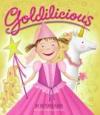
This is the same cute, pig-tailed Pinkalicious character that readers will find in the first two Pinkalicious books. Simply drawn and very pink, she's nearly always smiling and seems confident in her way of seeing the world. In this case, it is a starry magical world of unicorns, flowers, clouds, and lots of pink and purple. Her unicorn, called Goldilicious presumably because of her profuse mane and tail of flower-strewn golden locks, changes from being a solid white animal to a more translucent one depending on who's in the room. Later, she merges with the clouds and shows up as a constellation of stars.
The story makes several strong points though it's not so clever as the illustrations, and loses its focus at times. The strongest, most captivating scenes, both artistically and verbally, are those when Pinkalicious plays with Goldie. And though the lesson is not crystal clear, parents and kids should find plenty to capture their attention, and discuss, in its very magically majestic pages. Kids who like this book should definitely read Pinkalicious, and maybe Purplicious by the same author. Pages are filled with pinkness ... and flowers and lace, which will appeal to most Pinkalicious fans. Others may find the pastel tones and two-dimensional illustrations a little flat.
Talk to Your Kids About ...
Families can talk about why Pinkalicious can see the unicorn while no one else can. What is an imaginary friend? Have you ever had one?
At first Peter can't see the unicorn, then in the middle he seems to. Why did that happen? What changed?
Why didn't Pinkalicious play along with Peter when he pretended the worm was a cinnamon stick, or when he said the unicorn had turned into a mermaid? What did Pinkalicious say? Do you see a difference between pretending and imagining?
Is a unicorn a real animal? Where else have you seen them?
How did Pinkalicious respond when her parents told her it was time to go to bed? How did she change the way she answered? Why? What would you have done?
Book Details
- Author :
- Illustrator : Victoria Kann
- Genre : Picture Book
- Book type : Fiction
- Publisher : HarperCollins Children's Books
- Publication date : May 26, 2009
- Number of pages : 40
- Last updated : January 6, 2026
Did we miss something on diversity?
Research shows a connection between kids' healthy self-esteem and positive portrayals in media. That's why we've added a new "Diverse Representations" section to our reviews that will be rolling out on an ongoing basis. You can help us help kids by
Suggest an Update
Common Sense Media's unbiased ratings are created by expert reviewers and aren't influenced by the product's creators or by any of our funders, affiliates, or partners.
See how we rate