







Common Sense Media Review
 By Susan Faust
,
based on child development research. How do we rate?
By Susan Faust
,
based on child development research. How do we rate?
An imaginative invite to walk and think like Charles Darwin.
Parents Need to Know
Why Age 4+?
Any Positive Content?
Where to Read
Parent and Kid Reviews
What's the Story?
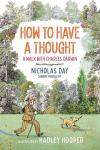
Readers are invited to take a walk in the style of naturalist Charles Darwin in HOW TO HAVE A THOUGHT. He used his walks to think. The story begins by telling what would be needed, for example, a walking stick, a route or loop as it is called, and rocks to count loops. The story then goes back a couple hundred years to introduce a young Darwin and describe his five-year, round-the-world journey. Along the way, he noticed much about the natural world, for example, fossils of a giant sloth in Argentina and different kinds of finch in the Galapagos. Once back at his country estate in England, he walked around the property with his dog Polly and thought. He'd make a pile of rocks at the start of his loop and then knock off a rock after completing each loop. That way, he knew if he had been thinking about an easy problem (one rock) or a hard one (three, even four rocks). Thus, he formulated the ideas about natural selection and evolution, about how creatures adapt to their environments to survive. Mentioned are poet William Wordsworth, physicist Albert Einstein, and writer Virginia Woolf. "They all walked their way toward hard thoughts. You can too." And therein lies the concluding invitation. The four-page back matter includes a bibliography of sources (no kids' book listed) and tells more about Darwin, his work, and the controversy over his ideas.
Is It Any Good?
This original biography may inspire young readers to take a long walk and think original thoughts in the style of the great naturalist, Charles Darwin. That is the imaginative invitation issued by the meandering, multi-layered nonfiction picture book How to Have a Thought: A Walk with Charles Darwin. Kids get an intro to metacognition (thinking about thinking), and they also learn about Darwin along the way. In addition, from the author's note, kids learn about what it means to stand up to controversy, as Darwin did. His revolutionary ideas about natural selection and evolution set off an immediate uproar, echoes of which still persist today. Original art seamlessly incorporates images from Darwin's times, lending a period-piece look to the package. Instructions about how to take a walk (get a walking stick, find a loop to walk, and finally count your loops using a pile of rocks) are quaint, even quirky. Psychology, biography, and natural history intertwine in this unusual melange that is at once serious and delightfully droll. The book's invitation to take a long walk and just think might be seen as an antidote to our screen-reliant world.
Talk to Your Kids About ...
Families can talk about Darwin's walks in How to Have a Thought. What is the value of taking a walk for Darwin? Do you like to go on walks or hikes? If so, what do you notice about your surroundings? Do you get new ideas when you are out and about? Like what?
Have you ever heard about natural selection or evolution? If so, what do you know? Have you ever wondered why, for example, bird species differ, having different kinds of beaks?
Charles Darwin was a scientist, and he asked lots of questions. He was curious. What are you curious about? How do you satisfy your curiosity?
In his work, Charles Darwin persevered over many years to develop revolutionary ideas about natural selection and evolution. He was also courageous because his ideas upset many religious people. Have you ever had to muster courage to express your ideas? How did you feel?
Book Details
- Author :
- Illustrator : Hadley Hooper
- Genre : Picture Book
- Topics : Adventures , Animals ( Wild Animals ) , History ( Biopic ) , STEM ( Nature , Science )
- Character Strengths : Courage , Curiosity , Perseverance
- Book type : Non-Fiction
- Publisher : Neal Porter Books
- Publication date : January 13, 2026
- Publisher's recommended age(s) : 4 - 8
- Number of pages : 32
- Available on : Nook, Hardback, Kindle
- Award : Common Sense Selection
- Last updated : February 5, 2026
Did we miss something on diversity?
Research shows a connection between kids' healthy self-esteem and positive portrayals in media. That's why we've added a new "Diverse Representations" section to our reviews that will be rolling out on an ongoing basis. You can help us help kids by
Suggest an Update
Common Sense Media's unbiased ratings are created by expert reviewers and aren't influenced by the product's creators or by any of our funders, affiliates, or partners.
See how we rate