







Common Sense Media Review
 By Regan McMahon
,
based on child development research. How do we rate?
By Regan McMahon
,
based on child development research. How do we rate?
Tween resists gender expectations in candid graphic novel.
Parents Need to Know
Why Age 10+?
Any Positive Content?
Where to Read
Parent and Kid Reviews
What's the Story?
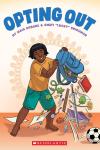
When OPTING OUT begins, Saachi and her best friend Lyla are finishing sixth grade and looking forward to seventh. Then Saachi gets her first period and she experiences all sorts of changes. She'd rather not think about her body, or being a girl, but she's being bombarded by the implications of both. By the time they launch into seventh grade, their classmates begin to start "dating" and becoming "couples." Her best friend Lyla starts to hang out with a boy and Saachi's afraid she's lost Lyla forever. She feels isolated and confused, but knows she wants to be a successful writer and submits a couple of poems to a magazine that publishes work by teen writers. After they get rejected, she decides to write about what she's really struggling with—her gender identity. But if that poem is accepted, will she have to tell her parents what's really going on with her?
Is It Any Good?
This candid, compassionate graphic novel portrays a creative middle schooler befuddled by puberty and questioning her gender identity. Opting Out shows a 12-year-old feeling uncomfortable with the changes in her body, her classmates, her friendships. In that way it's very relatable, even though the story is specifically about an Indian American middle schooler's gender identity struggle. And unlike a lot of middle-grade and YA books, the main character is not in conflict with her parents. They support her and assure her they will respect her choices going forward. The book itself respects what preteens go through at this delicate juncture. As Saachi reflects, "Growing up is so complicated."
The co-authors' art effectively zeroes in on Saachi's emotions and frustrations, highs and lows, outbursts and brooding moments, showing her changing facial expressions and reflecting her moods through body language. It also amplifies Saachi's commitment to and aspirations for her writing (working on poems alone in the library and at home, sharing her work with a friend) and underscores her perseverance in the face of rejections and the thrill of a magazine's acceptance letter.
Talk to Your Kids About ...
Families can talk about the stress about conforming to gender that's shown in Opting Out. Did the story help you understand how a person could not feel like a girl or a boy but somewhere in the middle? Did you feel compassion for Saachi as she struggled to figure it out?
What expectations might a girl feel about how to dress and behave? What pressures might a boy feel to act or dress in a certain way?
Did the graphic novel format make it easier to grasp some of the concepts and conflicts? Is that format better for tackling sensitive issues? Is it better for showing a character's emotions and confusion? Which are some of your favorite panels that capture how Saachi is feeling?
Book Details
- Authors :
- Illustrator : Swati "Lucky" Srikumar
- Genre : Graphic Novel
- Topics : Family Stories ( Siblings ) , Friendship
- Character Strengths : Communication , Compassion , Courage , Curiosity , Integrity , Perseverance
- Book type : Fiction
- Publisher : Graphix
- Publication date : May 5, 2026
- Publisher's recommended age(s) : 10 - 12
- Number of pages : 256
- Available on : Paperback, Nook, Hardback, Apple Books, Kindle
- Last updated : July 7, 2026
Did we miss something on diversity?
Research shows a connection between kids' healthy self-esteem and positive portrayals in media. That's why we've added a new "Diverse Representations" section to our reviews that will be rolling out on an ongoing basis. You can help us help kids by
Suggest an Update
Common Sense Media's unbiased ratings are created by expert reviewers and aren't influenced by the product's creators or by any of our funders, affiliates, or partners.
See how we rate