







Common Sense Media Review
 By John Sooja
,
based on child development research. How do we rate?
By John Sooja
,
based on child development research. How do we rate?
Teams studying black holes make breakthroughs in worthy doc.
Parents Need to Know
Why Age 11+?
Any Positive Content?
Where to Watch
Videos and Photos


Black Holes: The Edge of All We Know


What's the Story?
In BLACK HOLES: THE EDGE OF ALL WE KNOW, two teams work to make significant breakthroughs in solving some of the problems black holes have created since their introduction and mathematical defense in the early 1970s by Stephen Hawking. Now widely regarded as true and real, the nature of black holes remains intensely mysterious. Initially, Hawking proposed that nothing could or does escape a black hole, no information, no light, no energy, nothing. But in recent decades, further work, much of which was also done by Hawking, has posited otherwise. Meanwhile, another team works to generate an accurate picture of a black hole for the first time. Released to the public on April 10, 2019, this historical moment required over 10 years of effort, hundreds of people, 60 institutions, and a network of researchers and scientists across 20 different nations and regions.
Is It Any Good?
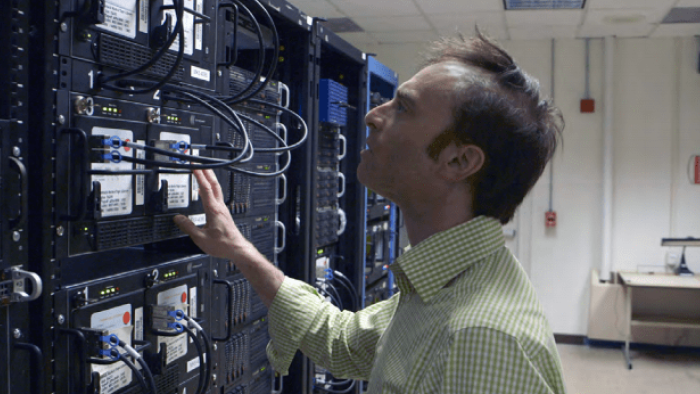
This surprisingly engaging docu follows around two teams trying to solve some unsolved problems about black holes. Very watchable, Black Holes: The Edge of All We Know doesn't try to explain too much. This allows the human element of these explorations into the unknown to really shine, as ultimately, these breakthroughs are simply hundreds of people collaborating with each other, sharing information, asking questions, and posing new challenges. Human ingenuity and brilliance are on full display here, as well as teamwork. The film also sadly features some of the last footage of Stephen Hawking and not of an interview but of him simply working and collaborating with his colleagues. This behind-the-scenes approach works well here. In terms of pacing, it helps that each team works toward a clear and understandable goal (the mathematicians need a specific solution and the telescope team needs their data to be globally accurate). Once the two teams begin to reach their goals, the feeling of being there with them on their inspiring and world-changing journeys is palpable.
The fly-on-the-wall approach helps balance out the interviews and expository parts.
Talk to Your Kids About ...
Families can talk about teamwork in the scientific community. What surprised you the most about the collaboration and teamwork shown in Black Holes: The Edge of All We Know? Was watching this kind of work inspiring?
If this documentary were to be made into movie adaptation with actors and a script, would any changes need to be made for it to be exciting? What would you add, if anything?
What team excited you most, the team of mathematicians or the Event Horizon Telescope team? Why?
Movie Details
- On DVD or streaming : March 2, 2021
- Cast : Malcom Perry , Shep Doeleman , Andrew Strominger , Sasha Haco , Stephen Hawking
- Director : Peter Galison
- Studio : Sandbox Films
- Genre : Documentary
- Topics : STEM
- Character Strengths : Communication , Teamwork
- Run time : 99 minutes
- MPAA rating :
- Last updated : September 29, 2025
Did we miss something on diversity?
Research shows a connection between kids' healthy self-esteem and positive portrayals in media. That's why we've added a new "Diverse Representations" section to our reviews that will be rolling out on an ongoing basis. You can help us help kids by
Suggest an Update
Common Sense Media's unbiased ratings are created by expert reviewers and aren't influenced by the product's creators or by any of our funders, affiliates, or partners.
See how we rate