








Common Sense Media Review
 By Barbara Shulgasser-Parker
,
based on child development research. How do we rate?
By Barbara Shulgasser-Parker
,
based on child development research. How do we rate?
'90s noir-mystery has violence, language, racism.
Parents Need to Know
Why Age 15+?
Any Positive Content?
Where to Watch
Videos and Photos

Devil in a Blue Dress

Parent and Kid Reviews
What's the Story?
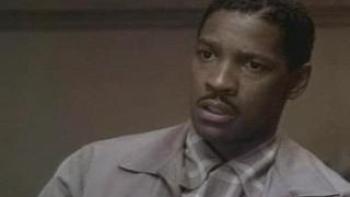
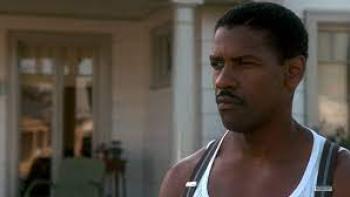
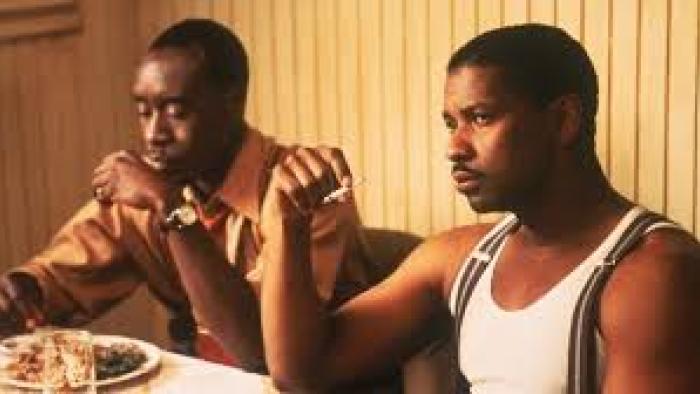
In DEVIL IN A BLUE DRESS, it's 1948 and Easy Rawlins (Denzel Washington) is recently back from fighting in World War II. He owns his own house in a solidly middle-class Black Los Angeles neighborhood but his security is upended when he's fired from a plant for working-while-being-Black, it's implied. Jobs are hard to come by. When Easy's bartender friend vouches for a fishy White guy named Dewitt (Tom Sizemore) offering a lot of money to find a White woman who likes hanging out at Black jazz clubs, Easy ignores his instincts and takes the cash. In no time a woman he knows is murdered, as is a man he's just met. White police officers like Easy for the crimes, but people keep threatening him and/or offering him money to continue to look for Daphne (Jennifer Beals), who is a rich politician's (Terry Kinney) fiancée and may hold the key to deciding a mayoral election.
Is It Any Good?
Like The Big Sleep, The Maltese Falcon, and the other over-complicated noirs that this mimics, there is much to like in Devil in a Blue Dress and equally much to roll your eyes about. We understand Easy needs the money when he's offered a clearly not-so-kosher job. But when he agrees to do a second job for the sleazy, gun-toting Dewitt, Easy's naivete makes us question how such a dupe could have survived fighting in the war. He makes one ill-advised decision after another, long after it's clear that everyone is using him, lying to him, and setting him up for crimes he didn't commit. It makes no sense when a woman with cab fare asks him to drive her someone at four in the morning to pick up a letter. Yet he agrees to play chauffeur. Then, out of nowhere, 47 minutes into the action, he figures out every missing piece of every puzzle, anticipates where everyone will be, announces everyone's motives and strategies without any evidence whatsoever, and becomes the strategic superior of every experienced fictional sleuth from the deductive Sherlock Holmes to the little-grey-celled Hercule Poiret. Washington's appeal, magnetism, and slow-walked charisma keep us glued to the action even when it feels absurd, even when Easy behaves foolishly, even when the whole plot seems unusually dumb.
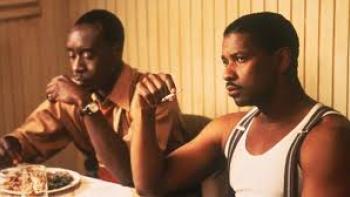
Although Don Cheadle gives an amusing performance as the trigger-happy Mouse, the plot would have worked fine without him and his inclusion sets up another reason for us to question Easy's good sense. When Mouse (Cheadle) is told not to shoot someone, even we can tell that seemingly simple assignment isn't going to turn out well. Yet Easy is shocked and annoyed to find the guy dead. "If you didn't want him killed, why did you leave him with me?" Mouse asks with impeccable reasoning, calling into question Easy's judgment yet again. In the end, for all its flaws, the movie offers something sweet and good as Easy happily surveys his house and neighbors enjoying their kids. We bask in the appreciation that wells up in him -- despite all he's been through -- of the perks of middle-class life in the post-World War II, corrupt, racist America depicted here. With the exception of this optimistic ending, the movie mostly evokes the feeling of the post-World War II black-and-white noirs that were characterized by the pessimistic dread triggered by a fear of nuclear annihilation.
Talk to Your Kids About ...
Families can talk about the dearth of Black directors and Black leading characters in movies in general, especially back in 1995, when this film premiered. Have things changed?
How does the movie depict the obstacles placed in Easy's way just because he is Black?
Easy is introduced as a savvy, skeptical guy, yet he keeps making obviously silly choices that suggest he isn't so savvy or skeptical. Does the movie reconcile that contradiction, or does it not matter?
Easy is worried about being seen in public with a White woman. How does racism demonstrated by White police officers and regular citizens compare with the kind of racism depicted in the news today?
Movie Details
- On DVD or streaming : September 29, 1995
- Cast : Denzel Washington , Tom Sizemore , Jennifer Beals
- Director : Carl Franklin
- Studio : Netflix
- Genre : Drama
- Run time : 102 minutes
- MPAA rating :
- MPAA explanation : violence, sexuality and language
- Award : NAACP Image Award - NAACP Image Award Nominee
- Last updated : October 8, 2026
Did we miss something on diversity?
Research shows a connection between kids' healthy self-esteem and positive portrayals in media. That's why we've added a new "Diverse Representations" section to our reviews that will be rolling out on an ongoing basis. You can help us help kids by
Suggest an Update
Common Sense Media's unbiased ratings are created by expert reviewers and aren't influenced by the product's creators or by any of our funders, affiliates, or partners.
See how we rate