







Common Sense Media Review
 By Jeffrey Anderson
,
based on child development research. How do we rate?
By Jeffrey Anderson
,
based on child development research. How do we rate?
Superior 2nd half of sci-fi epic has violence, fighting.
Parents Need to Know
Why Age 13+?
Any Positive Content?
Where to Watch
Videos and Photos


Dune: Part Two
Parent and Kid Reviews
Based on 40 parent reviews
Based on 70 kid reviews
Kids say this movie offers a mixed experience, with many praising its stunning visuals, compelling performances, and ambitious storytelling, but also expressing concerns about its excessive violence and complex plot that may be hard for younger audiences to digest. While some appreciate it as a fantastic sequel, others warn that the intense scenes and mature themes make it unsuitable for younger viewers, suggesting it is a film best enjoyed by teens and adults who can handle its dark content.
- violence concerns
- stunning visuals
- complex plot
- mixed audience reactions
- not for children
 Summarized with AI
What's the Story?
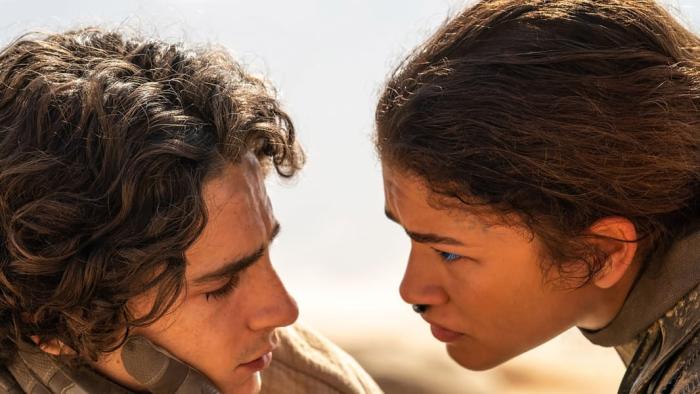
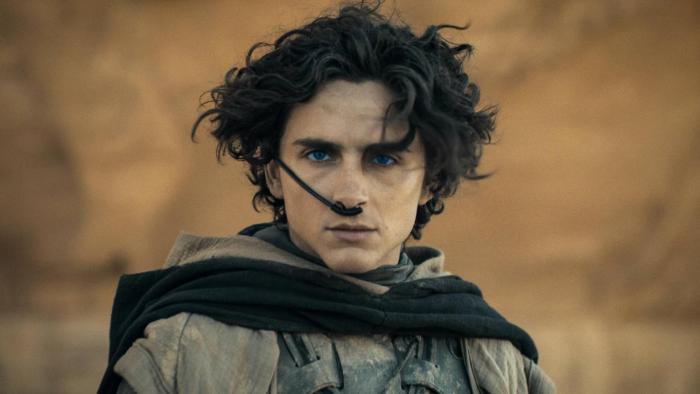
In DUNE: PART TWO, Paul (Timothée Chalamet) and his mother, Lady Jessica (Rebecca Ferguson), have been welcomed among the Fremen. Jessica drinks the Water of Life and becomes the new Reverend Mother, while Paul continues to face tests like surviving alone in the desert and riding sand worms. The Fremen regularly attack spice production plants, causing the evil Baron Harkonnen (Stellan Skarsgård) to send troops to shut the Fremen down. But the Fremen easily dispatch the invaders, who aren't acclimated to the desert atmosphere on Arrakis. Meanwhile, there are rumblings of a prophecy—encouraged by Jessica—that Paul may be the "chosen one" who's destined to lead the Fremen to paradise, although Paul publicly denies this. The Fremen are divided: Leader Stilgar (Javier Bardem) believes in the prophecy, but Chani (Zendaya), who has fallen in love with Paul, fervently doesn't. The Baron ups the ante by putting his cruel nephew Feyd-Rautha (Austin Butler) in charge of spice production on Arrakis. But Paul has been encouraged by his mother to drink the Water of Life (something no man has ever survived), and nothing will ever be the same.
Is It Any Good?
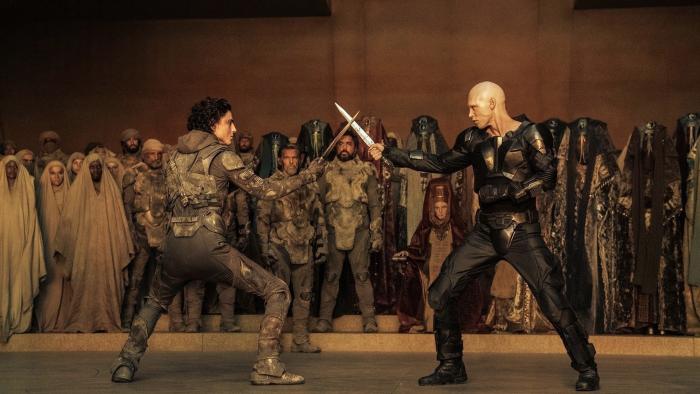
While this sequel isn't without stuffy, slow spots, it's far more propulsive than its predecessor, and it manages to tell an exceedingly complex story in a gloriously visual and compelling way. Now that we've moved past all the exposition required for this tale (as seen in Dune), Dune: Part Two jumps right into things, with the Fremen trying to get the attention of Baron Harkonnen and the emperor by attacking various spice plants. Some of the action scenes are effective and even exciting, but it seems as if director Denis Villeneuve doesn't exactly relish them; many fights are overly choreographed and cursory. (His best films, Sicario and Arrival, didn't require them, while his Blade Runner 2049 was dragged down by them.)
Yet Villeneuve's elegant, expansive compositions and wise storytelling make up for it. He and co-screenwriter Jon Spaihts have dug deep into Frank Herbert's dense source novel and found themes that aren't only relevant, but urgent. The movie questions the reasons behind leadership and quests for power and the deceptive tools—fear and faith—that can quickly and easily lead to power. As a result, Paul is no longer the shining hero he appeared to be in David Lynch's 1984 Dune. He's an opportunist who's seeking to use power for his own personal goals (in this case, revenge). And he's scarily familiar. Despite its flaws, Dune: Part Two is, along with its predecessor, an uncommonly intelligent, even daring entry into the canon of sci-fi action epics—and one that's worth discussing as much as it's worth enjoying.
Talk to Your Kids About ...
Families can talk about Dune: Part Two's violence. How did it make you feel? Was it exciting? Shocking? What did the movie show or not show to achieve this effect? Why is that important?
Why is "spice" considered a drug? Is it meant to represent drugs as we know them? Is it glamorized? Are there consequences for using it?
What are some of the movie's themes? How can sci-fi be used to explore real-life issues like the use of faith and/or fear as tools to rise to power?
How does this movie compare to the novel, the previous movie, and/or the TV movie? How is it different from those versions? How is it the same?
Is Paul a role model? What makes him seem heroic? What behaviors suggest otherwise? Would Chani be a better role model?
Movie Details
- In theaters : March 1, 2024
- On DVD or streaming : May 14, 2024
- Cast : Timothée Chalamet , Zendaya , Rebecca Ferguson
- Director : Denis Villeneuve
- Studio : Warner Bros.
- Genre : Science Fiction
- Topics : Book Characters
- Run time : 165 minutes
- MPAA rating :
- MPAA explanation : sequences of strong violence, some suggestive material and brief strong language
- Awards : Academy Award - Best Picture Nominee , Academy Award - Other Category Winner , Academy Award - Other Category Nominee , BAFTA - BAFTA Winner , BAFTA - BAFTA Nominee , Golden Globe - Golden Globe Award Nominee , NAACP Image Award - NAACP Image Award Nominee
- Last updated : October 9, 2025
Did we miss something on diversity?
Research shows a connection between kids' healthy self-esteem and positive portrayals in media. That's why we've added a new "Diverse Representations" section to our reviews that will be rolling out on an ongoing basis. You can help us help kids by
Suggest an Update
Common Sense Media's unbiased ratings are created by expert reviewers and aren't influenced by the product's creators or by any of our funders, affiliates, or partners.
See how we rate