

Ice Cube's cult classic has strong language; sexism, drugs.
Parents Need to Know
Why Age 16+?
Any Positive Content?
Parents Need to Know
Parents need to know that Friday is the first movie in a trilogy of ensemble comedies set in South Central, Los Angeles, written by and starring the rapper Ice Cube. Expect lots of drugs and language: One major character is a pot dealer who smokes his own inventory all day. Violence includes a shoot-out and a brutal fistfight; each blow lands with painful impact, and bricks, boards, and garbage cans are used as weapons. The movie leans on misogyny; women are mostly either sexual objects or used for scornful punchlines. Characters fill the air with sex talk, drug talk, and nonstop profanity ("f--k," "s--t," etc.), as well as racial and sexual insults (such as "knock the dust off that p---y"). Women are called "bitch," and the "N" word is used by Black characters.
To stay in the loop on more movies like this, you can sign up for weekly Family Movie Night emails
.
Language
a lot
Constant strong language includes "s--t," "f--k," "motherf--k," the "N" word (used by Black characters), "p---y," "t-ts," "ass," "bastard," "hell," "damn," "goddamn," and "bitch." Bathroom jokes, sex jokes, drug jokes, and various other off-color jokes.
Did you know you can flag iffy content?
Adjust limits for Language in your kid's entertainment guide.
One of the two main characters sells drugs and smokes pot throughout the movie. In one scene, he encourages someone else to try it, smoking three joints at once to prove that it's harmless. A character is shown high, running down the street in his briefs. Another hallucinates while high. Also references to Quaaludes, angel dust, and crack, and a minor character is referred to as a "crackhead." A character's mother sends him out for cigarettes.
Did you know you can flag iffy content?
Adjust limits for Drinking, Drugs & Smoking in your kid's entertainment guide.
A knockdown, drag-out fistfight feels absolutely real: Each blow lands with painful impact, and the fight, while largely bloodless, includes bricks, boards, and garbage cans being used as weapons. There's also a shoot-out that feels more stylized. A character keeps a gun in his room, and there's talk about how much of a "man" it makes him. Characters threaten one another, pull knives, and bully someone, punching them across the street (bruises visible in later scenes).
Did you know you can flag iffy content?
Adjust limits for Violence & Scariness in your kid's entertainment guide.
Several mentions of Kool-Aid. Converse shoes hang over multiple telephone lines. A character eats a cereal called "Crunchie" that shows the Cap'n Crunch mascot. Chevy Impalas and Ford Pintos are visible. During a scene in a convenience store, multiple products are visible on the shelf, including Nyquil, Tylenol, Excedrin, V05, Tums, Bayer, SOS, 409, Aunt Jemima, and Pop Secret. Miller, RC Cola, and Budweiser signs hang in a store.
Sex, Romance & Nudity
some
No nudity or on-screen sex, but characters talk about sex a lot. There's some flirting and several women in revealing clothing, notably a woman who's seen watering her front yard (in slow motion) while wearing tiny cut-off shorts and a tank top. Two characters are seen sleeping in bed together, and there's a suggestion of off-screen sex as one character goes inside a woman's house with the intention of seducing her.
Did you know you can flag iffy content?
Adjust limits for Sex, Romance & Nudity in your kid's entertainment guide.
Friday takes place in South Central, Los Angeles, in a Black neighborhood. But most characters reinforce stereotypes: Black male leads are unemployed, weed-smoking criminals who steal for selfish reasons. Despite supporting Black characters who seem hardworking, including someone who owns his own business, most characters are unmotivated. Young Black women work and attend school but somehow still give in to the freeloading men around them. The film leans on misogyny, with a female neighbor dressing in short-shorts while watering the lawn and later seen cheating on her spouse (who happens to be a little person—which is used for humor). When Latino characters enter the storyline, they're gangsters and drug dealers. Behind the camera, director F. Gary Gray is an African American man, and Ice Cube serves as one of the writers.
Did we miss something on diversity?
.
Positive Messages
very little
Poor behavior is played for laughs, but it isn't celebrated. Negative stereotypes of African Americans as lazy drug addicts are affirmed. Everyone solves their problems with violence.
Positive Role Models
very little
There are glimpses of goodness, but, in general, the overall behavior of the people in this neighborhood is iffy. Characters swear, gossip about one another, and laugh at one another's misfortunes. Characters use and sell drugs and shoot guns at one another; knives are also pulled. Characters steal from one another, and a character terrorizes the neighborhood with bullying behavior. Craig starts the movie as passive and helpless, but he learns to be active, stand up for himself, and do it without the help of the gun he keeps in his room. Some characters with good intentions are rewarded, and some with questionable motivations learn lessons.
Kids say the movie is full of humor and memorable characters, especially praising the performances of Ice Cube and Chris Tucker, but they highlight its inappropriateness for younger audiences due to extensive language, drug use, and violence. While some found it hilarious and relatable, others deemed it boring or lacking depth, suggesting it's best suited for mature teens and up.
language issues
drug use
humor appeal
character chemistry
maturity recommendation
Summarized with AI
What's the Story?
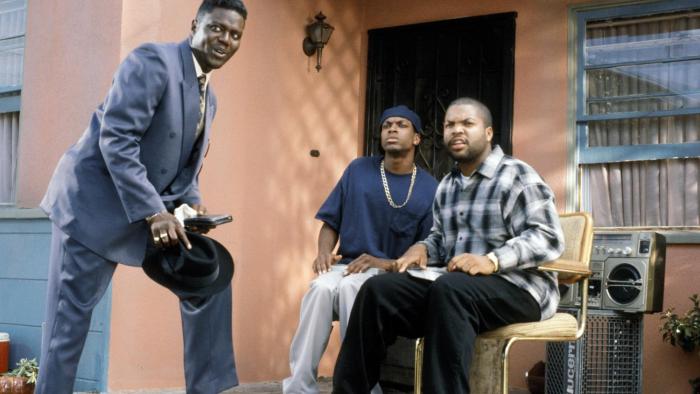
It's FRIDAY, and Craig (Ice Cube) has just lost his job—on his day off, too. Now he has nothing to do but hang out with his friend, a drug dealer named "Smokey" (Chris Tucker). As the day passes, they gossip about the kooky neighbors, avoid the block's menace, Deebo (Tommy "Tini" Lister Jr.), and smoke a little pot. Eventually, they must come up with $200 to pay back Smokey's boss or face his retribution. Meanwhile, Craig has developed a little crush on Debbie (Nia Long) and finds he must stand up to Deebo to protect her honor. Can Craig learn how to be a "man" without resorting to the violence that's all around him?
Though there's plenty of lowbrow humor here, the movie doesn't have the same hyped-up, eager-to-please vibe of many other comedies. Directed by F. Gary Gray (The Italian Job), Friday is fairly unique in the history of African American cinema. It's laid-back, with a refreshing lack of plot mechanics. This, plus the one-day, one-neighborhood setting, allows the characters to flourish in a more organic way. In a way, it's almost on a level with such classics as Charles Burnett's Killer of Sheep (1977) and Spike Lee's Do the Right Thing (1989).
That said, most of the film's humor is at the expense of other characters, and it has troubling elements of misogyny. Most of the women characters are seen as sexual objects or serve as the target of scornful punchlines. Little people are also made fun of. Friday's characters aren't meant to be role models, but, despite their slightly redeemable moments, they never fully change for the better.
Talk to Your Kids About ...
Families can talk about the drugs in the characters' lives in Friday. Did Craig learn a lesson after he smoked pot? Should he have given in when he didn't want to? Does Smokey learn any lesson about his drug use?
How did the film's violence make you feel? Was it thrilling, or did it have a harsher effect?
How did you feel about the women in the film? Did any of them seem like strong people, or were they stereotypes?
Inclusion Information
:
Black Movie Director(s)
,
African American Movie Director(s)
,
Black Movie Actor(s)
,
Female Movie Actor(s)
,
Black Movie Writer(s)
MPAA explanation
:
pervasive strong language and drug use, and for a brutal fight
Last updated
:
October 9, 2025
Did we miss something on diversity?
Research shows a connection between kids' healthy self-esteem and positive portrayals in media. That's why we've added a new "Diverse Representations" section to our reviews that will be rolling out on an ongoing basis. You can help us help kids by
Common Sense Media's unbiased ratings are created by expert reviewers and aren't influenced by the product's creators or by any of our funders, affiliates, or partners.