







Common Sense Media Review
 By Jeffrey Anderson
,
based on child development research. How do we rate?
By Jeffrey Anderson
,
based on child development research. How do we rate?
Smart, mature drama about race, privilege, and expectations.
Parents Need to Know
Why Age 16+?
Any Positive Content?
Where to Watch
Videos and Photos


Luce


What's the Story?
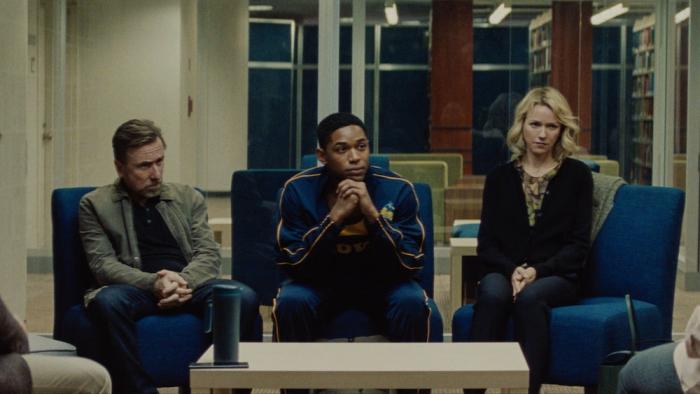
In LUCE, Amy (Naomi Watts) and Peter Edgar (Tim Roth) are proud of their adopted son, Luce (Kelvin Harrison Jr.), whom they rescued from war-torn Eritrea when he was a child. An accomplished student, debater, and athlete at his school, Luce nonetheless arouses suspicion in teacher Ms. Wilson (Octavia Spencer). She searches his locker and discovers illegal, deadly fireworks. Luce reacts with intellectual indignation, accusing Ms. Wilson of invading his privacy. Amy and Peter stick by their son, and it becomes clear that Ms. Wilson has a previous track record of investigating students -- and is also dealing with a sister, Rosemary (Marsha Stephanie Blake), who is mentally ill. Luce, meanwhile, is involved with a girl, Stephanie Kim (Andrea Bang), who may have been abused at a party. As the situation comes to a head, the truth becomes increasingly elusive.
Is It Any Good?
Based on a play by J.C. Lee, this drama is (unsurprisingly) talky and static, but it also tackles complex issues of race, privilege, and expectations in a deliberately inconclusive, provocative way. Co-written by Lee and director Julius Onah, Luce has a clean, unexceptional look, full of evenly lit interiors, and it contains a great deal of awkward expositional dialogue that explains the hard road it took for Luce and his parents to arrive where they are. But it gets power from what it doesn't show. The contraband fireworks and drugs become like a sleight-of-hand trick when it's revealed that Luce and his teammates share lockers, and the contents of any locker could belong to any of them.
In another example, Stephanie's ordeal at the party isn't seen, only described, from her own hazy point of view; Luce himself could have been one of her tormentors, or her rescuer, and the true answer is never known. Ms. Wilson is perhaps the most interesting character -- piloted by another masterful Spencer performance -- able to see a little more clearly than some, but not as clearly as others. Ultimately, the movie asks questions about how we view others, what we expect from them, and how we react when those expectations aren't met. Despite its flaws, Luce is a strong, effective, and useful movie.
Talk to Your Kids About ...
Families can talk about how Luce depicts sex and sexuality. How graphic is it? Why do you think the filmmakers made those choices? What values are imparted?
How are drinking and drug use portrayed? Are they glamorized? Are there consequences? Why does that matter?
Was Ms. Wilson right to breach Luce's privacy? How can you balance the importance of individual privacy against the safety of others?
What's the difference between how characters expect Luce to be and how he really is? How do characters react? What does this say about our world today?
What is the movie saying about privilege? Do you agree?
Movie Details
- In theaters : August 2, 2019
- On DVD or streaming : October 29, 2019
- Cast : Kelvin Harrison Jr , Naomi Watts , Tim Roth , Octavia Spencer
- Director : Julius Onah
- Studio : Neon
- Genre : Drama
- Run time : 109 minutes
- MPAA rating :
- MPAA explanation : language throughout, sexual content, nudity and some drug use
- Award : NAACP Image Award - NAACP Image Award Nominee
- Last updated : September 25, 2024
Did we miss something on diversity?
Research shows a connection between kids' healthy self-esteem and positive portrayals in media. That's why we've added a new "Diverse Representations" section to our reviews that will be rolling out on an ongoing basis. You can help us help kids by
Suggest an Update
Common Sense Media's unbiased ratings are created by expert reviewers and aren't influenced by the product's creators or by any of our funders, affiliates, or partners.
See how we rate