Funny musical is truly "fetch"; swearing, racy moments.
Parents Need to Know
Why Age 13+?
Any Positive Content?
Parents Need to Know
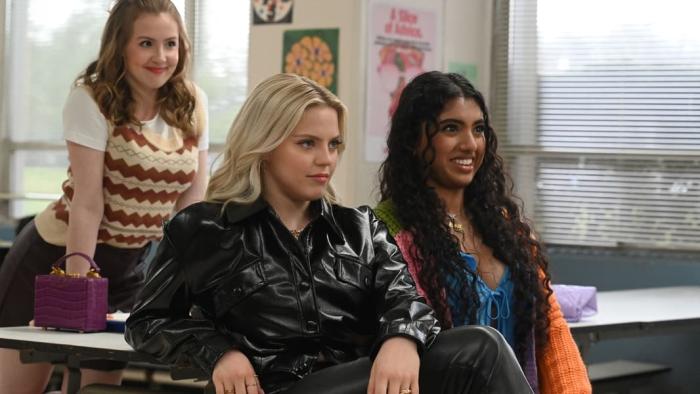
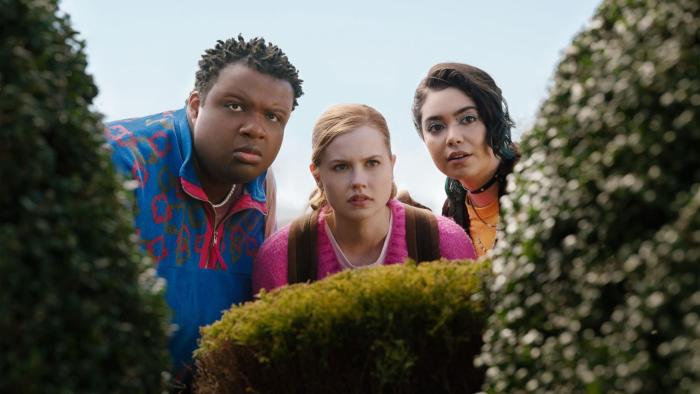
Parents need to know that Mean Girls (2024) is a high-spirited, hilarious musical take on the hit 2004 movie, adapted from the Broadway show. The teens have phones and social media in this version, but, like the original, the story centers on rivalry between high school juniors Cady Heron (Angourie Rice) and Regina George (Reneé Rapp), largely because of a boy. The take-away message of "what goes around, comes around" still rings true, capped with math teacher Ms. Norbury's (writer Tina Fey) observation that "calling someone stupid doesn't make you any smarter." Expect suggestive gestures and lingo, including a teen rapping about his skills "under the sheets," and mentions of one girl's high number of sex partners. There's also passionate, over-the-top kissing, plenty of cleavage, and a couple of numbers with sexy costumes/references. Language—from "a--hole" and "s--t" to "bitch" and "slut"—is fairly frequent. Teens drink in a couple of party scenes (including having shots), and there are references to vaping and an inhaler full of vodka. Violence is infrequent and played for humor but does include one potentially shocking moment. The original movie had some diversity, with supporting characters who were gay, and 2024's version continues that trend. Cady's friends Janis (Auli'i Cravalho)and Damian (Jaquel Spivey) are still queer, but now they're also people of color who each get their own mini-romances. And the student body covers a spectrum of skin colors, sexual identities, body sizes, and more.
To stay in the loop on more movies like this, you can sign up for weekly Family Movie Night emails
.
Sex, Romance & Nudity
some
A love triangle drives much of the plot. Teens make out, and students are shown in a sex education class with "condoms" and "safe sex" written on the chalkboard. Teen boys are shown shirtless in a few scenes, and one raps about his skills "under the sheets." Teen girls wear short skirts/shorts, low-cut shirts, and crop tops; bras and cleavage are seen. There's a number about dressing sexy on Halloween that includes lots of skimpy costumes; the Plastics' talent show performance is also suggestive. Sexual gyrations for comic effect and references to having sex. Physical beauty is shown to be important to romantic connections; Regina, in particular, is shot with camera angles and wind to highlight that she's "sexy." Some characters run their hands over their breasts. Karen's number of sex partners is mentioned more than once, sometimes in an attempt to make her feel bad. It's mentioned that a girl is "crotch sitting" with a boy (i.e., she's in front of him on a bench, with his legs around her as he sits above).
Did you know you can flag iffy content?
Adjust limits for Sex, Romance & Nudity in your kid's entertainment guide.
Language includes "s--t," "a--hole," "bitch" (and "beyotch"), "crap," "d--k," "hell," "bastards," "fricking," "pissed," "fugly," "losers," "screwed over," "shut up," "slut," "dumb," "damn," "horny," "freak," "stupid," and "oh my God." "Motherf----n'" is said, but the profanity is comically twisted so that the actual word isn't said. Middle-finger gesture is used frequently in a specific music number. Janis is referred to as a "pyro lez," a slur related to her sexuality, but in general characters don't seem to have an issue with characters' sexual identities.
Did you know you can flag iffy content?
Adjust limits for Language in your kid's entertainment guide.
Teens do shots and drink in party scenes, and Cady gets drunk. References to vaping, and jokes about heroin and a vodka-filled inhaler. A character recovering from a painful injury seems to be blissed out on her medication, which becomes a recurring joke. An adult drinks wine.
Did you know you can flag iffy content?
Adjust limits for Drinking, Drugs & Smoking in your kid's entertainment guide.
A key character is hit by a bus, but it happens so quickly that it's not really seen. Exaggerated fistfights break out in high school hallways, choreographed like a dance number. As the title indicates, there's quite a bit of mean behavior, even between "friends." Some online cruelty/bullying.
Did you know you can flag iffy content?
Adjust limits for Violence & Scariness in your kid's entertainment guide.
Products seen/featured include Cheetos, Lay's chips, iPhone/Apple products, Pure Leaf Tea, Secret deodorant, Honda, Perrier, Bubbly water, Spotify, Beanie Boo toys, and American Eagle.
Positive Messages
a lot
Having integrity and being yourself will bring you more happiness than trying to be someone else just to please others. Mean-spirited gossip hurts others and is likely to come back around and hurt the instigator. Putting others down may make someone feel temporarily superior, but "calling someone stupid doesn't make you any smarter." Women should be looking for opportunities to support one other, not diminish one another. Social media can turn someone into a hero or a pariah in moments.
Positive Role Models
some
Cady is smart and empathetic. She starts to lose those qualities when her social status rises, but she eventually rediscovers her integrity and her true self. Janis is an artist with a strong sense of self and style, but she uses Cady as a tool for revenge. Regina is frequently cruel but also has moments of vulnerability and proves capable of change. Gretchen, used to being belittled, eventually stands up for herself and acknowledges her worth. Adults are caring but largely hands-off (or overly involved in a cringey way).
Diverse Representations
some
This version of suburban Illinois' North Shore High is diverse in terms of students' and staff members' ethnicity, body type, sexual identity. Some students are still mocked for what makes them different (e.g., a gay character is called a "pyro lez"), but this is acknowledged to be wrong/problematic. Main characters Cady and Regina are White, as is central teacher Ms. Norbury (Tina Fey), but other characters represent a wider spectrum. Janis (played by Auli'i Cravalho, who has Hawaiian, Puerto Rican, Portuguese, Irish, and Chinese heritage) is a lesbian. Damien (Jaquel Spivey) is a big, gay Black man. Gretchen (Bebe Wood) mentions having an abuelita, and Karen is played by Indian American actor Avantika. Mathlete Kevin counters stereotypes somewhat by being an overly confident "nerd" (played by Bengali actor Mahi Alam). Regina gets in a traffic accident; she wears a neck brace for several scenes, some of which are played for humor. Movie was written by Fey and co-directed by Samantha Jayne, a White British woman, and Mexican filmmaker Arturo Perez Jr. Relationships between female characters are at the heart of the story, with teen girls caught up in stereotypes and cliquish behavior but (hopefully) learning the importance of supporting rather than diminishing one another.
Parents say the movie has sparked mixed reviews, with some praising its underlying messages about teenage struggles and friendships while others criticize its overt sexual content and suggestive themes, deeming it inappropriate for younger audiences. While some find it a fun adaptation of the original and musical, many parents express concern over its PG-13 rating, arguing that it lacks sensitivity towards young viewers and should be rated higher due to its controversial themes.
inappropriate for children
mixed reviews
sexual content
some positive messages
ratings controversy
Summarized with AI
age 12+
Based on 79 kid reviews
Kids say the 2024 musical adaptation of the beloved film is a mixed bag; while many appreciate its energetic performances and catchy songs, significant concerns arise regarding its inappropriate content for younger audiences. Most reviewers agree it's better suited for teens aged 13 and up due to the heavy sexual references, swearing, and overall mature themes, although some enjoyed the modern take and representation, noting it's not as good as the original but still has its entertaining moments.
inappropriate for kids
mixed reviews
better for teens
catchy musical numbers
modern take
Summarized with AI
What's the Story?
In this version of MEAN GIRLS—which is based on the stage musical that was adapted from the 2004 movie—Cady Heron (Angourie Rice), long homeschooled on an African savanna, moves to Illinois and finds the high school social hierarchy to be similar to the animal world. She's unexpectedly welcomed into the A-list clique, known as The Plastics, by the school's queen bee, Regina George (Reneé Rapp). But Cady feels Regina's sting when they both want to date Aaron Samuels (Christopher Briney).
Put your worries aside: The Mean Girls musical slaps. It's hard to believe anyone wouldn't have a good time watching this tuneful, somewhat campy reimagining of Tina Fey's early 2000s hit. Given that the original film was enjoyed by many of 2024's parents when they were young, this version offers them a laugh-out-loud arm squeeze that they can squeal over right alongside their teens.
Best positioned for those who know and love the Lindsay Lohan version, this take on Cady's story ratchets everything up a notch: the story elements, the humor, even The Plastics' cleavage. While it's impossible not to miss the phenomenal original cast, the talent here pays homage without copying their work. Rapp's Regina George isn't a persnickety devil in a Santa miniskirt; she's a sexy "apex predator" who roars, a bully somehow even more arrogant in her ability to make anyone wither. With witty song lyrics that seem destined to become teen anthems, 2024's Mean Girls—like its predecessor—is likely to be a must for teen get-togethers. Mean has never been so nice.
Talk to Your Kids About ...
Families can talk about high school cliques: What has changed over the decades, and what hasn't? Does the way cliques are portrayed in Mean Girls feel realistic?
Compare the musical adaptation to the original: What changes do you spot besides the music? Why do you think those adjustments were made? What feature film do you think would make a great musical? Why?
What role do phones and social media play in this version of the story? How do they impact Regina and Cady's choices and reputations?
Why is "the love triangle" a popular story element? Why do you think female friends fighting over a guy is considered a negative stereotype? What's the impact when entertainment depicts a certain group of people behaving in the same way over and over again?
How do Regina and Cady allow their power to go to their head, and what does it take for them to find their integrity?
Research shows a connection between kids' healthy self-esteem and positive portrayals in media. That's why we've added a new "Diverse Representations" section to our reviews that will be rolling out on an ongoing basis. You can help us help kids by
Common Sense Media's unbiased ratings are created by expert reviewers and aren't influenced by the product's creators or by any of our funders, affiliates, or partners.