







Common Sense Media Review
 By Jeffrey Anderson
,
based on child development research. How do we rate?
By Jeffrey Anderson
,
based on child development research. How do we rate?
Classic Oscar winner has explicit material, mature themes.
Parents Need to Know
Why Age 17+?
Any Positive Content?
Where to Watch
Videos and Photos


Midnight Cowboy
What's the Story?
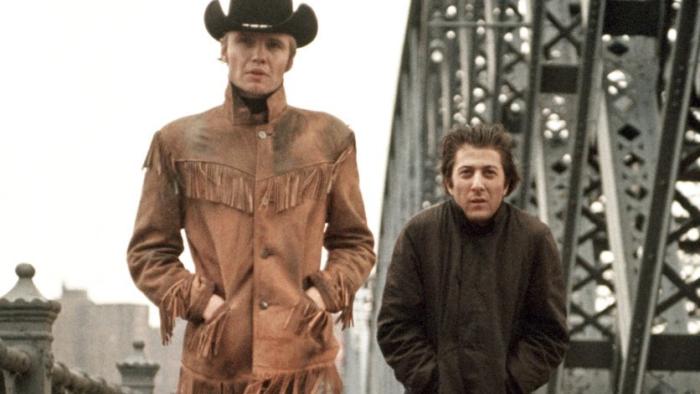
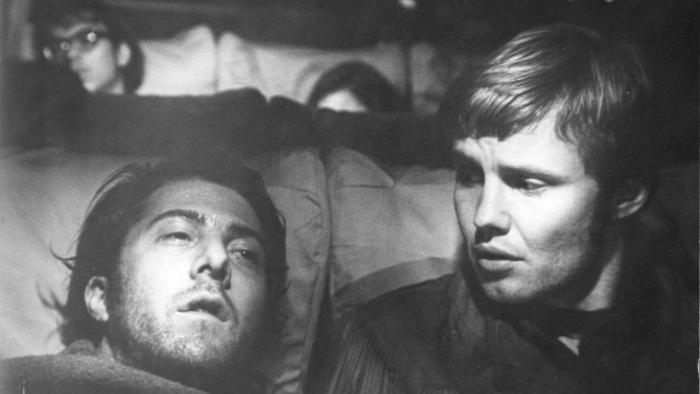
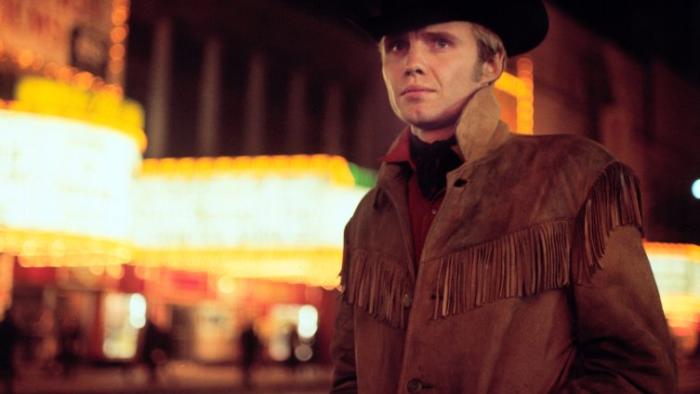
A Texas dishwasher who dresses in cowboy garb, Joe Buck (Jon Voight) packs up and heads to New York to become a hustler, selling his sexual services to rich women. Unfortunately the unsophisticated Joe fails in his first few attempts. He meets a small-time con man, "Ratso" Rizzo (Dustin Hoffman), who at first tries to fleece Joe but ends up taking him in to his room in a condemned building. Ratso and Joe go to a crazy party, and Joe takes drugs and hallucinates. In flashbacks, the uncomfortable, disturbing events of Joe's life are revealed. Ratso's health deteriorates, and Joe tries to help him fulfill his dream of moving to Florida. But is it too late?
Is It Any Good?
Dingy and foreboding but nonetheless full of life, this movie was one of the year's top hits and won three Oscars, for Best Picture, Best Director, and Best Screenplay (Waldo Salt). Actors Jon Voight, Dustin Hoffman, and Sylvia Miles all were nominated. Harry Nilsson's warm, sad theme song "Everybody's Talkin'" also was a hit, and Hoffman's line, "I'm walkin' here!" became one of the all-time classic movie quotes.
In 1969, times were changing, and movies were changing, too. MIDNIGHT COWBOY was an unabashedly adult movie with adult themes and experimental touches, and it took Englishman John Schlesinger to bring this approach to an otherwise gritty New York story. Schlesinger turns in a film of constant visual conflict, centered on the tall, blonde, handsome Joe and the short, dark, scraggy, greasy Ratso. Joe's sunny optimism about the life that awaits him, and what he actually gets, are at odds. Realism also conflicts sharply with the psychedelic party scene.
Talk to Your Kids About ...
Families can talk about the sexuality in the movie. Is it meant to be titillating, or does it have a darker side? How frequently does sex connect to love? Money? Violence?
Why do you think this movie is considered a classic?
Despite its grittiness, and all the bad things that happen in it, is the movie ultimately hopeful? What do the characters hope for?
What do the flashbacks show? How explicit are they? What ideas were they trying to convey? How do they affect the present-day story?
Does this movie seem like an Oscar winner for Best Picture? Does it seem as if it ought to have an X rating?
Movie Details
- In theaters : May 25, 1969
- On DVD or streaming : January 1, 2000
- Cast : Jon Voight , Dustin Hoffman , Sylvia Miles
- Director : John Schlesinger
- Studios : United Artists , MGM/UA
- Genre : Drama
- Run time : 113 minutes
- MPAA rating :
- Award : Golden Globe - Golden Globe Award Winner
- Last updated : August 2, 2022
Did we miss something on diversity?
Research shows a connection between kids' healthy self-esteem and positive portrayals in media. That's why we've added a new "Diverse Representations" section to our reviews that will be rolling out on an ongoing basis. You can help us help kids by
Suggest an Update
Common Sense Media's unbiased ratings are created by expert reviewers and aren't influenced by the product's creators or by any of our funders, affiliates, or partners.
See how we rate