







Common Sense Media Review
 By Jeffrey Anderson
,
based on child development research. How do we rate?
By Jeffrey Anderson
,
based on child development research. How do we rate?
Lowbrow, unfunny romcom about horrible people and droids.
Parents Need to Know
Why Age 15+?
Any Positive Content?
Where to Watch
Videos and Photos


Robots


Parent and Kid Reviews
What's the Story?
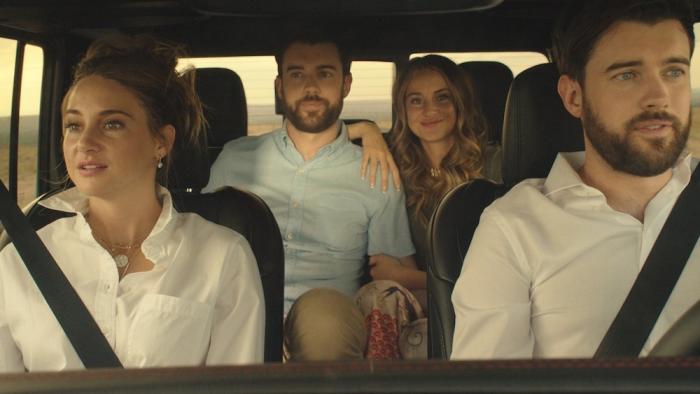
In ROBOTS, it's the year 2023. Charles (Jack Whitehall) is a lazy womanizer who uses an illegal robot double, C2, to handle his dull workday and to seduce women for him. While trying to close the deal with his latest conquest, Elaine (Shailene Woodley), there's a mix-up. Charles accidentally sends C2 on the date while finding himself at a board meeting. To confuse matters even more, C2 actually meets Elaine's own illegal robot, E2, on the date, and they hit it off. After spending the night together, the robots announce to their humans that they're in love and plan to take over the humans' identities. Meanwhile, Charles realizes that Elaine has had a scheme similar to his going, using her robot to con men into buying expensive gifts for her. At the same time, she figures out Charles' tricks. Even though they can't trust or stand one another, they must team up to save what's left of their humanity.
Is It Any Good?
It's perhaps ironic that the movie's filmmakers would use cutting-edge robot technology to create such a primitive, dunderheaded, and borderline insulting movie, a romcom unfit for humans or droids. Robots uses the screwball-comedy formula, dating all the way back to the 1930s, in which two potential partners make each other crazy before realizing that they're in love (see Bringing Up Baby for the classic template). Here, both Charles and Elaine are horrible, unfunny characters that we don't want to spend any time with. Their redemption, pulled off in just about 90 minutes, is unearned; it would take a lot longer to redeem these two. (Couldn't the writers have come up with something more interesting than the old "womanizer" and "gold-digger" stereotypes?)
Their situation is is basic and blunt, relying on cheap scatological and sex-related gags, such as Charles urinating on his robot in the shower or the E3 "sex-doll" version of Elaine dressed in pigtails, a miniskirt, and white stockings. It should have been possible to find some humanity, soul, or tenderness in this situation, some kind of connection between flesh and machine, such as in the movie Making Mr. Right (1987) or Lars and the Real Girl. Or, perhaps, since the robots are the more likable characters here, how about a story in which they dispatch their worthless human doubles, a la Horrible Bosses? As it is, Robots is a broken-down thing that likely belongs in the recycling bin.
Talk to Your Kids About ...
Families can talk about Robots' violence. How did it make you feel? Was it exciting? Shocking? What did the movie show or not show to achieve this effect? Why is that important?
How does the movie view sex? Are consent and trust addressed? How?
How does the movie draw comparisons between robots and immigrants to the United States? What do you think the movie is trying to say on this subject?
When do the characters learn to act selflessly, to think about others and not themselves first? How does it turn out for them?
Movie Details
- In theaters : May 19, 2023
- On DVD or streaming : May 19, 2023
- Cast : Shailene Woodley , Jack Whitehall , Paul Jurewicz
- Directors : Casper Christensen , Anthony Hines
- Studio : Neon
- Genre : Comedy
- Topics : Robots
- Run time : 93 minutes
- MPAA rating :
- MPAA explanation : pervasive language and sexual content
- Last updated : October 8, 2026
Did we miss something on diversity?
Research shows a connection between kids' healthy self-esteem and positive portrayals in media. That's why we've added a new "Diverse Representations" section to our reviews that will be rolling out on an ongoing basis. You can help us help kids by
Suggest an Update
Common Sense Media's unbiased ratings are created by expert reviewers and aren't influenced by the product's creators or by any of our funders, affiliates, or partners.
See how we rate