







Common Sense Media Review
 By Jennifer Green
,
based on child development research. How do we rate?
By Jennifer Green
,
based on child development research. How do we rate?
Historical drama lacks subtlety but has positive messages.
Parents Need to Know
Why Age 10+?
Any Positive Content?
Where to Watch
Videos and Photos


Ruby Bridges
What's the Story?
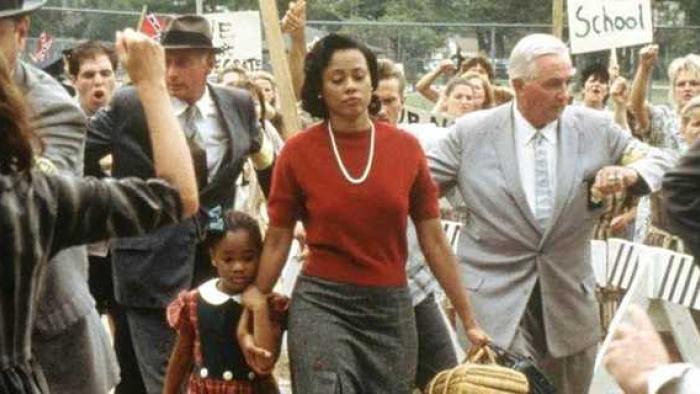
RUBY BRIDGES is based on the real-life story of a 6-year-old Black girl (Chaz Monet) selected by the NAACP due to her high test scores to attend an all-White school in New Orleans in 1960. Although desegregation of schools was national law, many areas in the South were slow or resistant to carry out the policy. In the film, Ruby's parents (Michael Beach and Lela Rochon) agree to send her to the school, even though she has to be protected by U.S. Marshals due to increasingly violent protests outside. Other parents pull their White children out of classes, and Ruby's presence causes resentment among the all-White staff. Mrs. Henry (Penelope Ann Miller), a recent transplant from Boston, is assigned as Ruby's teacher and advocates on behalf of her student's rights and integration. Ruby's family also receives support from the NAACP, their local community, and a White psychiatrist (Kevin Pollak) who volunteers his services. Thanks to this support, along with the love and strong faith instilled by her family, Ruby is able to weather the experience and make an important impact.
Is It Any Good?
This has all the hallmarks of a TV movie, with overly expository dialogue and heavy-handed music telling viewers exactly what to think and feel in key scenes. Such manipulative direction might typically turn off more mature audiences, but Ruby Bridges' true story would leave only the coldest of viewers indifferent. Played with impressive emotion by Monet, little Ruby is a deeply moving character who's depicted as resolute in the face of death threats, racist insults, and exclusion by other kids.
Ruby's experience was memorialized in a famous Norman Rockwell painting that positions the child as a lonely heroine. The film takes a different stance, showing how Ruby grapples with the trauma of her experience through broad support from her stalwart mother, loving father (an excellent Beach), psychiatrist (Pollak, looking a little stiff in the role), and religious faith. "Jesus faced a mob, too, just like you," Ruby is told. Such messages of determined resistance against discrimination remain incredibly relevant today.
Talk to Your Kids About ...
Families can talk about the history of desegregating schools in the United States, as well as the life story of the real Ruby Bridges. Where could you learn more?
Why do you think Ruby was so brave? Can you imagine living an experience like hers? How would you get through it?
Do you think Ruby's parents made the right decision to send her to the all-White school? Why or why not?
Why do you think the protestors were so hateful toward Ruby? How do you feel about the other children's reactions to Ruby?
Did you find Mrs. Henry's explanation of slavery appropriate for a first-grader? Do you know anything about the history of the KKK?
Movie Details
- In theaters : May 8, 1998
- On DVD or streaming : January 18, 1998
- Cast : Penelope Ann Miller , Kevin Pollak , Michael Beach , Chaz Monet
- Director : Euzhan Palcy
- Studio : Disney
- Genre : Drama
- Topics : Activism , History
- Character Strengths : Courage
- Run time : 96 minutes
- MPAA rating :
- Last updated : September 30, 2025
Did we miss something on diversity?
Research shows a connection between kids' healthy self-esteem and positive portrayals in media. That's why we've added a new "Diverse Representations" section to our reviews that will be rolling out on an ongoing basis. You can help us help kids by
Suggest an Update
Common Sense Media's unbiased ratings are created by expert reviewers and aren't influenced by the product's creators or by any of our funders, affiliates, or partners.
See how we rate