








Common Sense Media Review
 By Joyce Slaton
,
based on child development research. How do we rate?
By Joyce Slaton
,
based on child development research. How do we rate?
Medical procedures, swears in superb wellness-scams show.
Parents Need to Know
Why Age 14+?
Any Positive Content?
Where to Watch
Videos and Photos




Apple Cider Vinegar


What's the Story?
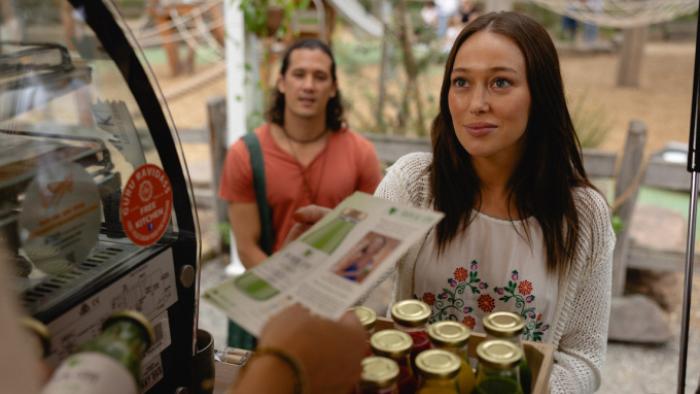
A lie spins out of control in APPLE CIDER VINEGAR, a series based on the 2017 book The Woman Who Fooled the World about the rise and fall of "wellness" entrepreneur Belle Gibson (Kaitlyn Dever), the real cancer patients who followed her "natural" alternative therapies, and the journalists who eventually exposed her. Mixing in actual detail from the case, fictionalized portraits of other wellness influencers and women battling cancer, and faux news stories and interviews, this series tells a true (or at least true-ish) story "based on a lie," as viewers are told repeatedly.
Is It Any Good?
Kaitlyn Dever makes a sad, sympathetic, and sensational Belle Gibson, a woman with a complicated backstory who spreads lies about both her medical history and the natural-food diet she said cured it. In less capable hands, Apple Cider Vinegar could have been a simple look at a reprehensible villain whose attention-seeking mistruths harmed, maybe even killed, those who listened to her—the sort of true crime document that's legion on both streaming and conventional TV networks. Instead, with creator Samantha Strauss at the helm (as well as in the writers room), and with Dever's extraordinary performance, this story of a troublesome and troubled woman is something much odder and more interesting: a portrait of one woman who exemplifies something terrible about most (or at least many) of us.
As Apple Cider Vinegar shows us, this fictional Belle Gibson never set out to hurt anyone; instead, her lies began as a cry for attention. We see how lonely she is in the series' first episode, calling her mom to convince her (clearly not for the first time) to show up for the baby shower Belle is throwing for herself, then staying up late into the night to make cupcakes to celebrate herself and her baby. No guests ever arrive to shower her with anything like love. And so Belle tells a lie about her health on a message board for moms-to-be ... and she likes the loving attention she gets for doing so. Before long, she's launched a mini-empire online, with an app touting her supposed whole-food cancer cure. The only problem? Real women listen to her, such as Milla (Alycia Debnam-Carey), who's desperately trying to escape her doctors' advice that she amputate her arm to battle her cancer, and Lucy (Tilda Cobham-Hervey), who finds hope in Belle's alternative therapies when her doctors give her little to none. Slowly, painstakingly, Apple Cider Vinegar shows us how insidious wishful thinking can be, how the wrong kind of support is better than none at all, and how some women seek "wellness" as shorthand for the power and agency they lack. Apple Cider Vinegar is bracing, enraging, and relatable all at once, a powerful potential explanation for the why's these cases often spark.
Talk to Your Kids About ...
Families can talk about true crime documentaries and television shows. What parts of Apple Cider Vinegar are "true" (or at least based on the truth), and which are fictional? Does it matter? Do "true crime" narratives have a duty to have fidelity to real-life events? Or can they justify changing characters, dialogue, and events to make shows more entertaining or impactful?
Have you read the book on which Apple Cider Vinegar is based? An often-repeated maxim says that books are always better than movies. If you have read the book, do you agree? Why, or why not?
How are viewers supposed to feel about the Belle Gibson portrayed in this show? Are we supposed to relate to her? To hate her? To feel sorry for her? How can you tell? How is she presented in this series, and how does that presentation affect how you feel about her?
TV Details
- Premiere date : February 6, 2025
- Cast : Kaitlyn Dever , Alycia Debnam-Carey , Aisha Dee
- Network : Netflix
- Genre : Drama
- TV rating :
- Last updated : February 20, 2025
Did we miss something on diversity?
Research shows a connection between kids' healthy self-esteem and positive portrayals in media. That's why we've added a new "Diverse Representations" section to our reviews that will be rolling out on an ongoing basis. You can help us help kids by
Suggest an Update
Common Sense Media's unbiased ratings are created by expert reviewers and aren't influenced by the product's creators or by any of our funders, affiliates, or partners.
See how we rate