Parents need to know that Fargo was inspired by the Coen brothers' same-named movie—and, like the film, tells stories that paint a bleak, darkly comic portrait of Midwest towns that blossom into hotbeds of murderous activity. Expect lots of bloody violence: Characters, including innocent bystanders, are killed by gory stabbings, gunshots, bludgeoning, throat slitting, strangling, and decapitation. A dead body is disposed of with a meat grinder, and another lies in a morgue with its skull sawed open, brain visible. One storyline revolves around a survivor of domestic abuse—she's pursued and kidnapped by her ex-husband. Characters infrequently snort cocaine and talk about acid and "scoring weed," and a few struggle with addiction. Occasional drinking and smoking. Sexual content varies from season to season, with the first being the most intense. Characters have simulated sex, including oral sex, on-screen, nude butts occasionally visible. The word "f--k" is sparingly used, but there's plenty of "s--t," "ass," "goddamn," "hell," "bitch," "p---y," etc. Bigots spew hate speech ("fairy," "retard," "cripple," and "d-kes") while offensive terms like "Chinaman," "gook," "red man," and "half-breed" are used neutrally by White characters. Most characters are White men, but heroes skew female. Men of color are tokenized early on, but Season 4 has many Black and Italian immigrant characters in nuanced roles. There's positive representation for White men with disabilities, including a man with cerebral palsy, a man with obsessive compulsive disorder, and a Deaf character—all in key supporting roles. Topline themes are dark, showing how good people can make poor decisions that spin wildly out of control, with innocent people caught in the crosshairs. This mature drama features many recognizable actors, including Martin Freeman, Kirsten Dunst, Ewan McGregor, Chris Rock, Jon Hamm, Jennifer Jason Leigh, and others.
Violence & Scariness
a lot
Violence isn't constant, but when it happens, it's very graphic: blood spraying, spurting, pouring. Characters, including innocent bystanders, are killed by gory stabbings, gunshots, bludgeoning, throat slitting, strangling, decapitation. They're buried alive, poisoned, and crushed by falling objects. Close-ups on gruesome injuries include a broken shin, an infected wound, broken and rotted teeth with bleeding gums, etc. Dismemberment of ears, arms, fingers, with severed body parts shown. A dead body is disposed of with a meat grinder; another lies in a morgue with skull sawed open, brain visible. Parents howl in grief over seeing or hearing about their children being dead (though sometimes the child is actually still alive). A kid is coerced by an adult into shooting and killing another child. Mass shootings with visible dead bodies. An adult is cruelly bullied by his high school tormentor. A mother/wife has cancer; discussions and images of chemotherapy. Shots of animal cruelty include a dead deer in a trunk, a dog with a slit throat. Teens play with crossbows, accidentally shooting one another. A man's shower runs with pig's blood; he screams. A character ritualistically bathes in animal blood. Crickets infest a supermarket, covering everything; shoppers scream and run. Characters vomit and fart. A man takes his pants off and sits on a toilet; splashing sound heard (nothing sensitive visible). Close-ups on streams of urine going into cups for drug testing and on a bloody used tampon. A man lies and manipulates a woman into having sex; during sex she says "You're hurting me," and he briefly apologizes but doesn't stop. The series generally avoids depictions of sexual assault, but Season 5 centers on a survivor's story of domestic, underage sexual abuse; victim shown pursued and held hostage by her abuser. She discusses her painful history with others (no sexual violence shown on-screen), and forensic photos of her battered body are handled by a police officer.
Did you know you can flag iffy content?
Adjust limits for Violence & Scariness in your kid's entertainment guide.
"F--k" is used infrequently, but there's plenty of "s--t," "ass," "damn," "goddamn," "hell," "piss," "bitch," "p---y," "t-ts," "d--k," "c--ksucker," "whore," and "pr--k." "Oh my God" and "Jesus Christ" are used as exclamations. Overt bigots spew hate speech with words like "fairy," "retard," "cripple," "chief," "miscegenation," "dykes," "wop," etc. A White character with the last name "Nygaard" is taunted by another White character who calls him "N--gered" (a pun on the "N" word). He's also called "Chief Wigwam" for using a bow and arrow. White characters casually say "Chinaman," "gooks," "oriental," "half-breed," "hermaphrodites"; call Native people "red man" and "the Indian" (sometimes to their face); and mispronounce "Arabs" as "Ay-rabs." None of it is portrayed as inappropriate. Other terms used neutrally in 1950s settings include "Negro," "colored," and "Mormon." Rude hand gestures such as jerking off accompanied with the line "She gave me a tug once" and middle-finger gestures. Sexually explicit language ("I let you come inside of me," "I can still feel your finger in my ass," etc.).
Did you know you can flag iffy content?
Adjust limits for Language in your kid's entertainment guide.
Sexual content varies from season to season, with the first being the most intense. Characters have sex, including oral sex, on-screen—they're shirtless and in underwear or implied naked, with nude butts occasionally visible. A couple takes a bath together, scenes take place at a strip club, and characters indulge in consensual kinks like BDSM and erotic asphyxiation. Teens throw around a naked plastic blow-up doll. Through a window, a Hasidic Jewish woman takes off her wig, then makes eye contact with a man and takes off her dress to reveal her bra and panties. Characters occasionally appear in nonsexual situations wearing just their underwear (boxers, bra and panties). Themes of sexual violence come up in Season 5—see Violence & Scariness.
Did you know you can flag iffy content?
Adjust limits for Sex, Romance & Nudity in your kid's entertainment guide.
Characters infrequently snort cocaine and talk about acid and "scoring weed," and a few struggle with addiction. Characters also occasionally drink alcohol (rarely appearing drunk), and characters—mostly portrayed as unlikable—smoke cigarettes, pipes, and vape, including once inside a hospital. A victim's painkiller is swapped out for Adderall without his knowledge. A kid is pressured by an adult into taking a swig from a flask. A serial killer poisons her victims with strychnine and other substances. A minor character sells a wide range of drugs from the back of a van.
Did you know you can flag iffy content?
Adjust limits for Drinking, Drugs & Smoking in your kid's entertainment guide.
Characters drink Miller Lite in several scenes, and one season prominently features The Nightmare Before Christmas songs, Halloween costumes, and merchandise. Characters also mention Rachel Ray, Dairy Queen, Arby's, Bill Blass, Hamburger Helper, Facebook, Google, Bisquick pancakes, etc. A scene in Las Vegas shows hotels like the Mirage and a billboard for Phantom of the Opera.
Diverse Representations
some
Most characters across the series are White men. But heroes skew strongly female, with women like Molly Solverson, Gloria Burgle, and Dorothy Lyon shown as braver and more strategic than their male peers. Morally gray women like Peggy Blumquist and Lorraine Lyon are also written as whip-smart and independent. Men of color begin as tokenized one-offs, usually as enforcers working for White villains, and there's lots of racist language used to portray White characters as ignorant (see Language section for details). Early in the series, women of color are mostly absent—and hyper-sexualized when they do appear. But Season 4 is more inclusive, with several nuanced roles for Black and Italian immigrant characters and women of color in key roles, including E'myri Crutchfield (who's Black American) and Season 5's Richa Moorjani (Indian American). A U.S. Marshal who's a Latter-day Saint is portrayed as a religious zealot. There's positive disability representation for White men: An assassin in an important, recurring role is Deaf and played by Deaf actor Russell Harvard. Charlie Gerhardt has cerebral palsy, also played authentically by Allan Dobrescu. Odis, in a pivotal role, has obsessive compulsive disorder that's portrayed realistically. But a minor character has a stroke and appears for most of a season in a wheelchair; he's nonverbal and powerless. A character with implied bulimia is portrayed as a grotesque villain with rotted teeth. A few LGBTQ+ characters in minor and supporting roles, but most are killed.
Did we miss something on diversity?
.
Positive Role Models
a little
A few hopeful characters have integrity, perseverance, courage: Molly is a persistent sheriff's deputy, her dad Lou and later season's Rabbi Milligan and Deputy Witt Farr are caring protectors, Chief of Police Gloria Burgle has small-town pragmatism, clever student Ethelrida stays optimistic and honest despite the racist society she lives in, and suburban mom Dorothy is a fierce and street-smart survivor. But more characters (by far) have questionable moral compasses and a taste for violence. Some, such as salesman Lester Nygaard, corrupt parole officer Ray Stussy, gang leader Loy Cannon, and politically powerful Lorraine Lyon, do bad things for understandable reasons. Others, including assassin Lorne Malvo, extreme capitalist V.M. Varga, Italian Mafioso Gaetano Fadda, and vigilante sheriff Roy Tillman, are portrayed simply as violent, power-hungry monsters.
Positive Messages
very little
There's an ongoing search for truth and justice, but the overarching theme is that the world is bleak and treacherous. Evil deeds such as murder, kidnapping, bribery, lying, etc., aren't condoned and eventually have consequences, but many good and innocent people are hurt, killed, and martyred in the process.
Kids say this show is highly entertaining but comes with warnings about its graphic content, featuring intense violence, sexual themes, and strong language that might not be suitable for younger viewers. Many reviewers express that while the storytelling and acting are exceptional, the dark tone and frequent violent scenes can be hard to watch.
graphic content
dark tone
exceptional acting
not for kids
strong violence
Summarized with AI
What's the Story?
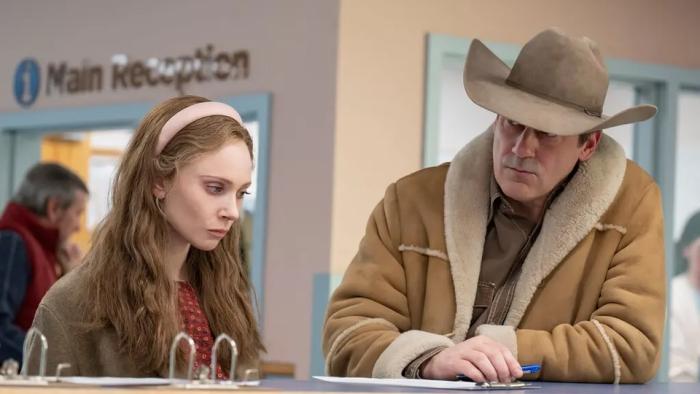
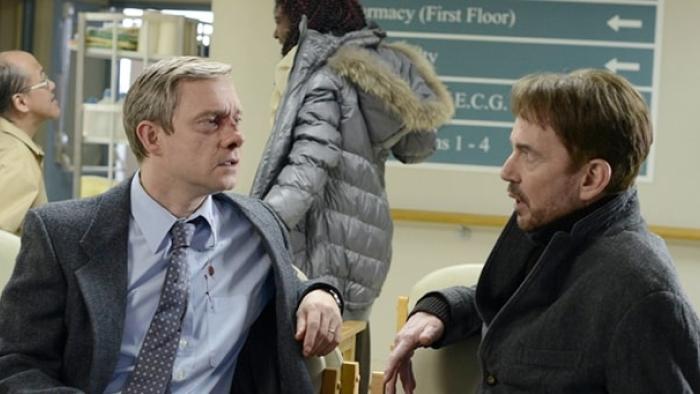
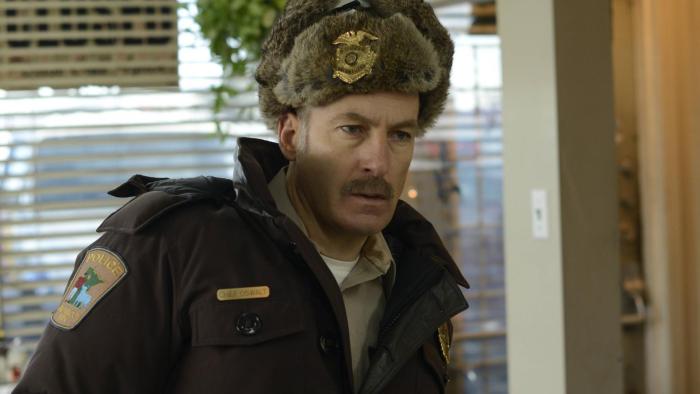
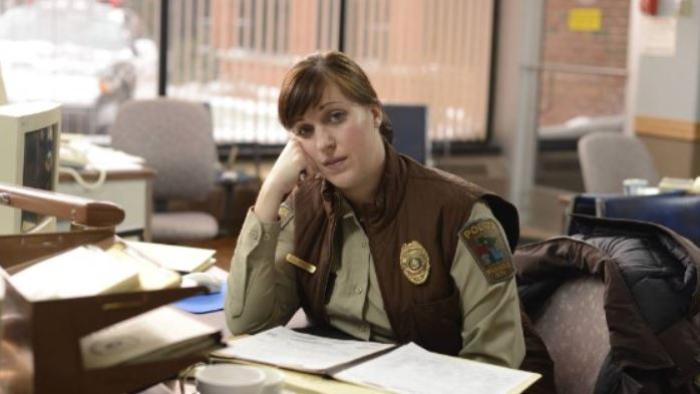
Adapted from Joel and Ethan Coen's Oscar-winning film of the same name, FARGO follows an assortment of mostly Midwestern characters whose stories collide in chilling ways. This anthology series has a different cast and storyline each season, but there are recurring themes: Scrappy, underdog heroes like Deputy Solverson (Allison Tolman) and Gloria Burgle (Carrie Coon) find themselves sorting through the chaos and deaths caused by everyday people who found themselves backed into a corner. Characters like Peggy Blumquist (Kirsten Dunst), Ray Stussy (Ewan McGregor), and Loy Cannon (Chris Rock) fight tooth and nail to get out of bad situations, their desperation attracting crime syndicates and other bad actors to circle like vultures. And relentless killers such as Lorne Malvo (Billy Bob Thornton), V.M. Varga (David Thewlis), and Roy Tillman (Jon Hamm) further cement the world of Fargo as a dangerous, dog-eat-dog place.
This stellar adaptation of a beloved movie is a heck of a good one, with ambitions that aim much higher than gimmicky "Oh, yahs!" and "You betchas!" Of course, just because Fargo is quality television doesn't mean its violence and bleak messages are a good fit for every family, so viewers should be prepared to see some things that will likely make them wince. More importantly, you should know your kid, know what they can handle, and know that at least there are artful messages about greed, debt, generational injustice, and hope lurking beneath all of the blood.
Talk to Your Kids About ...
Families can talk about Fargo's characters and who you're supposed to root for. Can the series' unhappy characters (e.g., Lester Nygaard, Dorothy Lyon) be victims as well as killers? Are assassins (e.g., Lorne Malvo, Gaetano Fadda) clear villains, or are they anti-heroes—and what's the difference?
How does Fargo compare to other TV crime dramas, particularly when it comes to the level of violence? Does this series glorify violence, or use it in a cautionary way? Where's the line between responsible and irresponsible depictions of blood and gore?
How does Fargo the TV series compare to Fargo the film? How many references to the movie can you find in the series? What about references to other Coen brothers films, from The Big Lebowski to No Country for Old Men?
What do you think about how the series portrays women? What makes characters like Molly Solverson and Ethelrida Smutny positive heroes? What about more complicated characters, like Peggy Blumquist or outlaw duo Zelmare Roulette and Swanee Capps? Who do you consider role models, and why?
Research shows a connection between kids' healthy self-esteem and positive portrayals in media. That's why we've added a new "Diverse Representations" section to our reviews that will be rolling out on an ongoing basis. You can help us help kids by
Common Sense Media's unbiased ratings are created by expert reviewers and aren't influenced by the product's creators or by any of our funders, affiliates, or partners.







 By Kari Croop
,
based on child development research. How do we rate?
By Kari Croop
,
based on child development research. How do we rate?


 Summarized with AI