
Satisfying 3rd story cycle has compelling dragon characters.
Parents Need to Know
Why Age 10+?
Any Positive Content?
Parents Need to Know
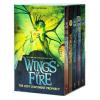
Parents need to know that The Lost Continent Prophecy is the third five-book "cycle" in the Wings of Fire dragon series by Tui T. Sutherland (The Dragonet Prophecy was the first, The Jade Mountain Prophecy the second, with a Legends Duology and four books in the Winglets series that follow). This series includes books 11-15: The Lost Continent, The Hive Queen, The Poison Jungle, The Dangerous Gift, and The Flames of Hope. Each is told from the perspective of a young dragon: two from the SilkWing tribe, one from HiveWing tribe, one from the LeafWing tribe, and the young queen from the IceWing tribe. The violence is even less in this series than in the others, mostly because a cruel queen that mind controls all her subjects would rather have more subjects to mind control than dead dragons, but also because dragons once bent on revenge against the queen find more peaceful solutions than all-out war. Dragons do fight, though, and hurt each other with venom that causes prolonged paralysis, poison darts, poisons that knock victims unconscious, stingers, acid spray, ants and toxic bugs that sting and bite, arson, claws, and more. One dragon dies in the present, stabbed with a thorn, and another breaks an arm. Many dragons fall unconscious after fighting and are imprisoned and threatened. One very young dragon is captured to be sacrificed. Jungle plants try to eat dragons, and in a tense scene, dragons are surrounded by deadly vipers. Most other content is pretty mild, with some flirting and professions of love, some drinks at a party served in a punchbowl, and put-downs like "idiot" and "nitwit." Expect a lot of social-emotional learning throughout the series, with lessons on controlling anger, expressing difficult feelings, and finding empathy for others.
Violence & Scariness
some
Dragons fight and hurt each other with mind control, venom that causes prolonged paralysis, poison darts, poisons that knock victims unconscious, stingers, acid spray, ants and toxic bugs that sting and bite, arson, claws, and more. One dragon dies in the present, stabbed with a thorn, and another breaks an arm. Many dragons fall unconscious after fighting and are imprisoned, threatened, and mind controlled. One very young dragon is captured to be sacrificed. Jungle plants try to eat dragons, and in a tense scene, dragons are surrounded by deadly vipers. Much backstory is given in all the books about traumatic events that shaped the present. These include the Tree Wars (50 years before) that killed many dragons and resulted in the enslavement of one species by another. Also, mentions of a plague that killed IceWings and their queen, stories of an animus mother dragon abusing her child for hundreds of years until the child killed her to be free, the story of limbs lost from a curse, humans sacrificed to a sentient Abyss, dragon eggs stolen by humans and baby dragons abused by humans, and how some dragons were orphaned or abandoned by their parents.
Did you know you can flag iffy content?
Adjust limits for Violence & Scariness in your kid's entertainment guide.
Nothing stronger than "heck," "jerk," and "that sucks," for swear words, but plenty of put-downs, standard and creative, like "idiot" (most often), "vacuous earthworm," "go suck a lime," "half-wit," "toad-sucking," "trolls," "nitwit," "dingbat," "stupid," "morons," "brat," and "bozo."
Did you know you can flag iffy content?
Adjust limits for Language in your kid's entertainment guide.
In the second story, drinks are served at a party in punchbowls, with a remembrance of a party where a dragon drank something bubbly that made them sleepy.
Did you know you can flag iffy content?
Adjust limits for Drinking, Drugs & Smoking in your kid's entertainment guide.
Most of the five stories are heavy on social-emotional learning. In the first book: There are things more important than following rules, especially if those rules are unjust. In the third book: How to decipher when anger is useful and when it's unproductive and harmful. In the fourth book: Empathetic leaders are the best leaders, and walking in other's shoes (or talons) is the best way to understand others. The second book emphasizes the power of the truth to change hearts and minds. The fifth book shows the power of teamwork, especially teamwork combined with diversity—dragons from both continents must work with humans to save the world. All stories look for ways around wars and killing more dragons.
Positive Role Models
a lot
In the first book, Blue, a SilkWing, goes from always following every rule to learning what rules should be broken and what rules are unjust. He's also an incredibly empathetic dragon who spends much time thinking of others' perspectives, even those his friends would call his enemies. In the second book, Cricket, a HiveWing, is very curious and enthusiastic about learning new things. She goes against her own tribe when she discovers the truth about the wrongs they've committed and professes that truth as loudly as she can. In the third book, Sundew was raised to be angry and seek revenge and is always arguing and hasty, until she starts listening to her girlfriend Willow, who teaches her when anger is justified and when it gets in the way of goals and relationships. In the fourth book, Queen Snowfall is a young, brand-new queen of the IceWings who is plagued with self-doubt and fear of others. Then a magic ring forces her to see through others' eyes, and she begins to rule with understanding and sympathy. In the fifth book, Luna bottles up all her sadness and worry until an unlikely friend teaches her to deal with them more openly, and even express them in her art.
Diverse Representations
some
The dragons aren't generally gender stereotyped. Girl and adult female dragons are fierce, brilliant, curious, thoughtful leaders, and sometimes war-mongering, controlling, and violent. Boy and adult male dragons are often gentle, kind, loyal, and conflict-avoidant, while a few are easily angered and tough. Dragons in all kingdoms are ruled by females. Each dragon tribe has a unique culture and many have biases or longstanding feuds with other tribes, which can be compared to real-life group differences. The HiveWings have even enslaved the SilkWings, who have no rights and must fight for them. Of the main character dragons, there's one lesbian pair, and two dragons from different tribes love each other even though it's forbidden. Two siblings and major characters are raised by two moms. One human named Axolotl uses "they"/"them" pronouns. Minor characters also include a pairing of two dragons from different tribes that is later sanctioned by the queen. Many dragons are orphaned, raised by one parent, or abandoned by parents, and some had parents taken away from them.
Did we miss something on diversity?
.
Educational Value
a little
The dragons on the continent of Pantala have adaptations similar to well-known insects and spiders, like stingers, four wings instead of two, silk webs, and cocoons. The SilkWings even undergo metamorphosis to grow their wings. The dragons also build homes like insects would, including intricate hives. Dragons appear in many fantasy series but not usually as the main characters or in a world ruled by dragons. Readers can compare the dragon lore here with that in other books they've read. They can also think about how the conflicts between tribes in these books might mirror conflicts in the real world. Some dragons are enslaved; others are refugees.
In THE LOST CONTINENT PROPHECY, on the continent of Pantala, SilkWing dragons live in hives enslaved to HiveWings, while HiveWings do the bidding of Queen Wasp. It's been this way since the Tree Wars 50 years ago, when the HiveWings destroyed the trees and all LeafWing dragons with them—or so everyone thought. When two SilkWings escape the hives because the queen wants their rare flame silk powers, they encounter LeafWings in hiding, ready to destroy the hives in retaliation. A war is brewing among the dragons of Pantala once again, and Queen Wasp's mind control is a formidable weapon that threatens more than just one continent. It will take LeafWings, SilkWings, HiveWings, humans, and even Pyrrhia's dragons working together to save them all.
This third series of dragon tales feels surprisingly fresh thanks to its novel setting and the attention paid to world building and the inner lives of its main dragon characters. The dragons on the continent of Pantala are curiously insect-like in their abilities and habits and are emotionally complex. Blue, the sweetest of the bunch, wants to understand everyone, even his longtime oppressors. Sundew is the fiercest, until her love for a pacifist interferes with her thirst for revenge against all HiveWings. Back on Pyrrhia, Queen Snowfall starts out as the most troubled and unlikable and has the biggest metamorphosis of all the dragons outside of a cocoon. Luna's personal story in the fifth book is the least compelling, but there's enough finale excitement to make up for it.
Each story of the five dragons has enough revelations to keep readers racing to the next. We learn about long-guarded HiveWing secrets when Clearsight's book is stolen, we learn about where and how the LeafWings have remained hidden for 50 years, we learn about the cruelest animus mom dragon of all time, we find out why humans and dragons originally fought, and we finally discover how exactly Queen Wasp controls her tribe—or does she? Each book holds its own and will keep dragon fantasy fans satisfied.
Talk to Your Kids About ...
Families can talk about Queen Snowfall's journey to empathy in the third book, The Dangerous Gift from The Lost Continent Prophecy. In Chapter 12, Snowfall says that the magic ring "was trying to hit her over the head with a lesson about sympathy and understanding. YUCK." How did she get that lesson? Whom did she learn empathy for? How will it make her a better ruler?
Available on
:
Paperback, Audiobook (unabridged), Hardback, Apple Books, Kindle
Last updated
:
March 9, 2026
Did we miss something on diversity?
Research shows a connection between kids' healthy self-esteem and positive portrayals in media. That's why we've added a new "Diverse Representations" section to our reviews that will be rolling out on an ongoing basis. You can help us help kids by
Common Sense Media's unbiased ratings are created by expert reviewers and aren't influenced by the product's creators or by any of our funders, affiliates, or partners.