







Common Sense Media Review
 By Weiting Liu
,
based on child development research. How do we rate?
By Weiting Liu
,
based on child development research. How do we rate?
Oscar-winning biopic shows painful effects of schizophrenia.
Parents Need to Know
Why Age 13+?
Any Positive Content?
Where to Watch
Videos and Photos


A Beautiful Mind

Parent and Kid Reviews
Based on 11 parent reviews
Based on 27 kid reviews
Kids say the film is an Oscar-winning biopic that is emotionally intense, with some referencing sex, violence, and mental illness that may be too tricky for younger viewers to fully grasp. While many appreciate the depth and educational aspects regarding schizophrenia, they note its mature themes suggest that it's more suitable for older teens and adults.
- intense themes
- suitable for older teens
- educational about mental illness
- strong performances
- emotionally powerful
- emotional depth
 Summarized with AI
What's the Story?
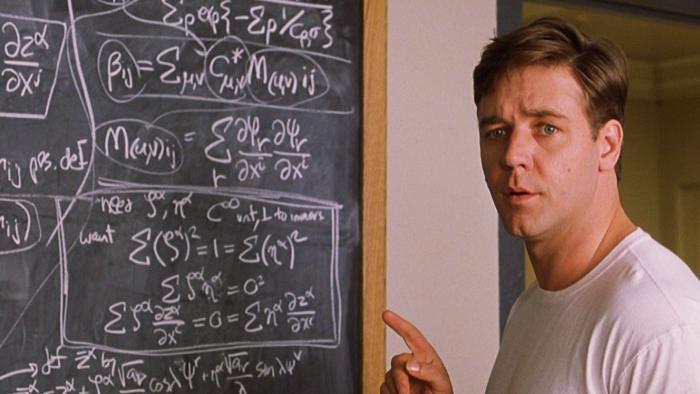
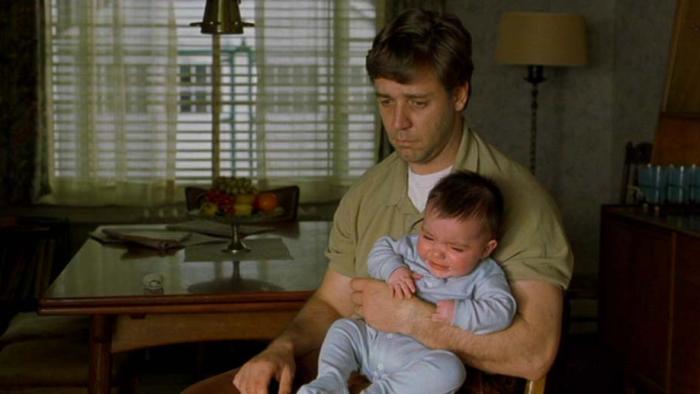
A BEAUTIFUL MIND follows John Nash (Russell Crowe), a brilliant but socially awkward mathematician who arrives at Princeton in 1947 with ambitions of making an original contribution to his field. As his pioneer work gains recognition, he's recruited to help break codes for the U.S. government during the Cold War. While building a life with his wife, Alicia (Jennifer Connelly), John begins to experience severe mental health challenges that blur the line between reality and delusion. As he takes on a long-term struggle to manage schizophrenia, he tries his best to hold onto his career, his family, and his sense of self.
Is It Any Good?
This is an extraordinary true story, and it's been made into an extraordinary movie. In A Beautiful Mind, Crowe is magnificent in a role that would provide irresistible temptation for showboating for most actors. There are superb performances by everyone in the cast, including Connelly (an Oscar winner for Best Supporting Actress), Paul Bettany, Ed Harris, Christopher Plummer, Judd Hirsch, and a dozen others.
What's really special here is the way that screenwriter Akiva Goldman and director Ron Howard present both Nash's genius and his mental illness in such compelling, cinematic terms. Both, in essence, become characters in the story as viewers go inside his head and wonder with Nash what to believe. This is what makes the movie more than a disease-of-the-week special with color-by-numbers "heartwarming" moments of triumph over adversity. At the same time, the film is still a Hollywood interpretation of real-life Nash's story—one that some viewers, particularly those with lived experience of mental illness, may find overly glamorized.
Talk to Your Kids About ...
Families can talk about how A Beautiful Mind depicts mental illness. Does it seem accurate, or is it glamorized for Hollywood? Where might you go to find out more about schizophrenia?
How does the film portray Alicia's role in supporting John? Does the film suggest that his achievements are partly built on her sacrifices? Does it acknowledge her perspective?
How do the characters demonstrate self-control and perseverance? Why are these important character strengths?
Movie Details
- In theaters : December 21, 2001
- On DVD or streaming : May 27, 2003
- Cast : Ed Harris , Jennifer Connelly , Russell Crowe
- Director : Ron Howard
- Studio : Universal Pictures
- Genre : Drama
- Topics : Book Characters , History ( Biopic ) , School ( College & Graduate School ) , STEM ( Science )
- Character Strengths : Perseverance , Self-control
- Run time : 135 minutes
- MPAA rating :
- MPAA explanation : intense thematic material, sexual content and a scene of violence.
- Awards : Academy Award - Best Picture Winner , Academy Award - Best Picture Nominee , Academy Award - Other Category Winner , Academy Award - Other Category Nominee , BAFTA - BAFTA Winner , BAFTA - BAFTA Nominee , Golden Globe - Golden Globe Award Winner , Golden Globe - Golden Globe Award Nominee
- Last updated : April 28, 2026
Did we miss something on diversity?
Research shows a connection between kids' healthy self-esteem and positive portrayals in media. That's why we've added a new "Diverse Representations" section to our reviews that will be rolling out on an ongoing basis. You can help us help kids by
Suggest an Update
Common Sense Media's unbiased ratings are created by expert reviewers and aren't influenced by the product's creators or by any of our funders, affiliates, or partners.
See how we rate