







Common Sense Media Review
 By Jennifer Green
,
based on child development research. How do we rate?
By Jennifer Green
,
based on child development research. How do we rate?
Predictable college-set adaptation has partying, sex.
Parents Need to Know
Why Age 15+?
Any Positive Content?
Where to Watch
Videos and Photos


After


Parent and Kid Reviews
Based on 60 parent reviews
Based on 171 kid reviews
Kids say that although the story has potential and some find it entertaining, the film's content is often criticized for being too explicit and promoting toxic relationships. Many reviewers express concerns about the depiction of sex and dating among teens, suggesting that it's not appropriate for younger viewers, and some label it as unrealistic or poorly written due to its clichés and heavy reliance on adult themes.
- toxic relationships
- overwhelming sexual content
- inappropriate for younger viewers
- mixed opinions on entertainment
- poor character development
 Summarized with AI
What's the Story?
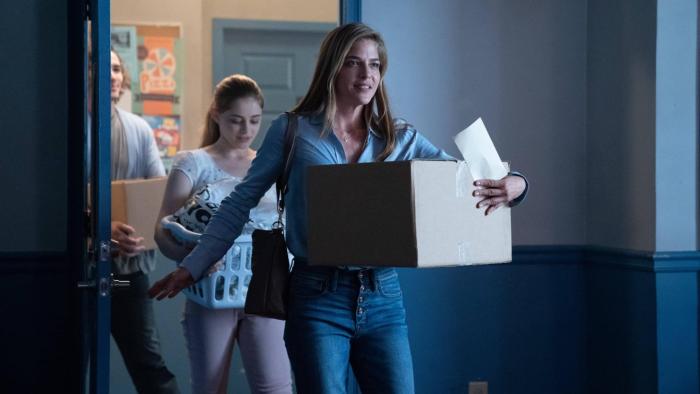
AFTER begins on the day that Tessa Young (Josephine Langford) is leaving home for college. Her mother, Carol (Selma Blair), is struggling to let go, especially when she meets her daughter's partying dorm roommate, but she's reassured because Tessa has always been responsible and hardworking. Tessa has also had the same boyfriend since she was a kid -- but that changes when she meets handsome, British-accented, poetry-reciting rebel Hardin Scott (Hero Fiennes Tiffin). The pair are set up in a Truth or Dare challenge at a raucous college party where the straitlaced Tessa feels woefully out of place. They bond, and then spar over their readings of classic novels. The more Tessa falls for Hardin and starts letting go of her rules and exploring her own desire, the more her structured world begins falling apart.
Is It Any Good?
Despite a predictable storyline and clichéd romance, After works, thanks in large part to the heartfelt performance of its young star, Josephine Langford. As Tessa, Langford appears in almost every scene, and with the camera regularly close in on her face, she conveys a sincere mix of self-restraint and hunger for new experiences, confidence and fragility. She's a credible college first-year student, and we believe her and feel for her as a young woman falling in love for the first time. What comes off as less authentic is the story's Pride and Prejudice-inspired romance, based on the cult One Direction fan fiction published by author Anna Todd on the site Wattpad and later as a book series.
The tale requires that Hardin appear to be both Tessa's opposite -- brooding, experienced, and rebellious, despite his father's top university post and wealth -- and also her equally vulnerable soulmate. Tiffin has the budding charisma and looks (he is a Fiennes, after all) to play the romantic lead, but his character here is contrived mostly as a device for Tessa's evolution. After is likely to attract a heavily female audience, but it could struggle to find its market. More mature viewers might find it too formulaic, while parents may keep younger teens away because of the explicit content.
Talk to Your Kids About ...
Families can talk about whether After offers a realistic portrayal of college life, and what high schoolers can expect when they go to college themselves. What are you looking forward to? What makes you nervous? How do you think this compares to other movies about college?
For those who've read Todd's book, what did the film change about the characters, story, and setting? What's your opinion about those changes?
How did you feel when you found out Tessa's friends had deceived her? Have you ever experienced or done something similar? What were the consequences?
Tessa faces a lot of peer pressure. What are some strategies she uses to avoid doing things she doesn't feel comfortable with? How do you handle peer pressure?
How does the movie depict sex? Is it different from how you've seen it portrayed in other movies? Parents, talk to your teens about your own values regarding sex and relationships.
Movie Details
- In theaters : April 12, 2019
- On DVD or streaming : July 9, 2019
- Cast : Josephine Langford , Hero Fiennes Tiffin , Selma Blair
- Director : Jenny Gage
- Studio : Aviron Pictures
- Genre : Romance
- Topics : Book Characters
- Run time : 106 minutes
- MPAA rating :
- MPAA explanation : sexual content and some college partying
- Last updated : September 30, 2025
Did we miss something on diversity?
Research shows a connection between kids' healthy self-esteem and positive portrayals in media. That's why we've added a new "Diverse Representations" section to our reviews that will be rolling out on an ongoing basis. You can help us help kids by
Suggest an Update
Common Sense Media's unbiased ratings are created by expert reviewers and aren't influenced by the product's creators or by any of our funders, affiliates, or partners.
See how we rate