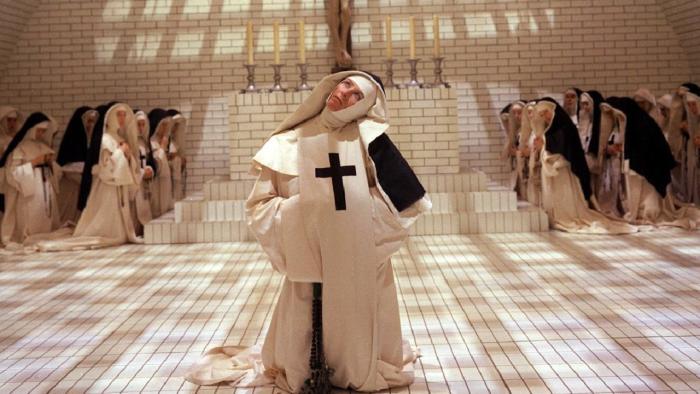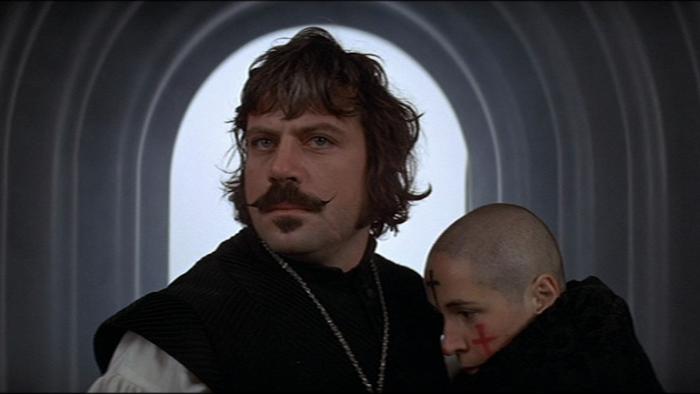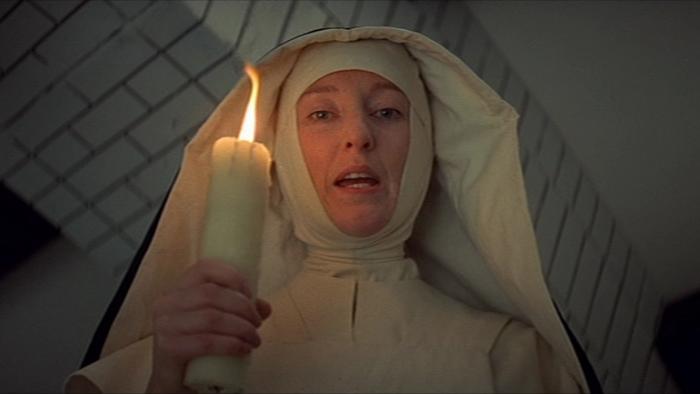


Parents need to know that The Devils is a controversial British historical psychological drama based on the true story of a 17th-century priest who is tried for witchcraft by the state so that it can claim the town he protects. This re-released, uncut version features graphic torture, violence, nudity, and sexual acts within a feverish and intense atmosphere. A character has their tongue cut out, people are crucified, and someone is burned alive. In one scene, a large implement is forced into someone's vagina to "exorcise" them. Sometimes considered blasphemous for mixing sexual elements and religion, it is arguably sympathetic to faith and damning of political corruption. The priest, Father Grandier (Oliver Reed), protects his town against the state, which plots to have people testify against him as a heretic. He remains true to his faith and morals, even when sentenced to death, showing self-control, courage, and compassion, while other characters revel in cruelty, torture, and bringing false charges against a priest. The film is directed by Ken Russell and also stars Vanessa Redgrave as Sister Jeanne, a nun who has lustful thoughts about Grandier.
To stay in the loop on more movies like this, you can sign up for weekly Family Movie Night emails
.
Violence & Scariness
a lot
Cruel torture scenes include someone's tongue being cut and wood being driven into someone's legs with a large hammer. Bloody wounds. Humiliating violence. A character is burned alive—their face blisters and chars. A character undergoes a cruel and painful examination of their genitals. They are dragged onto an altar and have a large implement forced into their vagina to "exorcise" them. Nuns are lashed and whipped. A nun causes a deep, bloody wound on their own hand while trying to suppress a sexual fantasy. After a nun masturbates, they flog themselves with a sharp metal whip. A large nail is driven into someone's hands during a crucifixion. Crucified people have bloody wounds. A nun attempts suicide by hanging. A nun bites someone's wrist, spits at them, and grabs their arm. A nun hits someone with a large crucifix, while another gleefully rips pages from a burning Bible. Set during the plague, there are many living and dead shown with gory, painful boils. Carts of bodies are poured into vast, full mass graves. The corpse of a tortured person spins on a wheel with maggots in its eyes and mouth. The king shoots people dressed up as birds for fun. People vomit during torture.
Did you know you can flag iffy content?
Adjust limits for Violence & Scariness in your kid's entertainment guide.
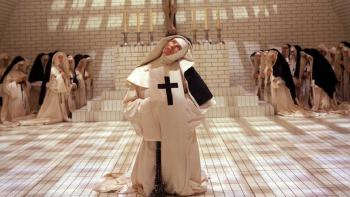
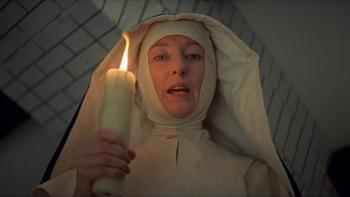
Nudity and sexual scenes. A key theme is a nun's battle with "impure thoughts" of a sexual nature and their attempts to suppress them. A nun's legs, hands, and pubic hair are shown while they masturbate. In a fantasy scene, they lick the wounds of a crucified person, and they kiss before having sex at the site of the crucifixion. Frenzied nuns strip off their clothes to show they are possessed by sin and frolic in a church. They take down a statue of Jesus and act like they are having sex with it. A nun with a candle between their legs licks the flame and rubs her hands up and down the candle. Nude nuns kiss. Shirtless nudity in a stage show where performers wear flamboyant costumes and makeup, one in a bikini. Upper-class people dress in drag to watch a show. A character has a conversation while topless. A scene implies a nun masturbates with a human leg bone.
Did you know you can flag iffy content?
Adjust limits for Sex, Romance & Nudity in your kid's entertainment guide.
Faith and religion can help guide people through times of internal and external turmoil. But they can also be twisted and used for corrupt means. Characters display integrity, compassion, courage, and self-control.
Positive Role Models
a little
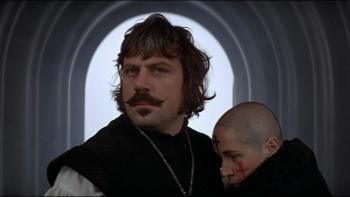
Father Urbain Grandier is a Catholic priest who stands up for the independence of his town against the king. He does not abide by the rule of celibacy but otherwise upholds his faith and acts accordingly, with kindness, mercy, and compassion. With integrity and courage, he puts himself in harm's way to save the town and becomes the target of a campaign to try him for witchcraft and seize the town. During his persecution he offers to pray for the people who are working against him. When sentenced, he shows self control and dignity under undignified and cruel circumstances of torture and humiliation. Baron de Laubardemont is tasked with the destruction of the town's fort and leads the conspiracy against Grandier. He uses the troubles of a nun, Sister Jeanne, as an opportunity to accuse Grandier of working with the devil. Jeanne becomes overrun with lustful thoughts about Grandier and is convinced she's possessed. Father Mignon is a key player in Grandier's downfall and shows some remorse. Few other characters do, instead reveling in the chaos they cause.
Diverse Representations
very little
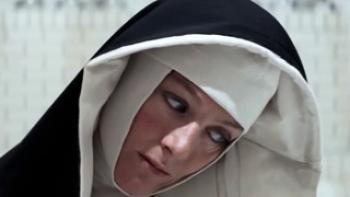
Sister Jeanne des Anges has a humped back and twisted spine, causing her to walk stooped and with her head to the side. During a bad dream, she imagines people mocking her while she tearfully defends herself and says that she's beautiful. She wakes up upset and pleads with God to take away her hump. This dream sequence ties her disability to shame and suffering. Cardinal Richelieu uses a standing wheelchair, which is pushed by two nuns. The cast is predominantly White. A Black woman in a crowd at a theater is seen kissing two people. The ruling class is shown to be out of touch and corrupt, whereas the townspeople and nuns are portrayed as easily led.
In THE DEVILS, Catholic priest Father Grandier (Oliver Reed) tries to defend his town against the forces of the king in 17th-century France. When a nun (Vanessa Redgrave) is overcome with lustful hysteria, Grandier's enemies seize the chance to frame him for witchcraft and take the town for themselves.
Is It Any Good?
Our review:
Parents say :Not yet rated
Kids say :Not yet rated
Ken Russell's classic 1971 psychological drama has a long history of being censored, banned, and locked away, but is now finally available in its full version. The Devils is a dizzying, equally gorgeous and grotesque movie that infuriates as it spotlights the systematic cruelty of corrupt power. The film is not anti-religious—the truly religious people in the movie discuss their issues within the framework of their faith and through this find strength and guidance. Instead, it is anti-corruption, with those who use violence to seize power shown as villains and sneering bullies who rule through chaos and humiliation. Packed with unforgettable images and a strong message that resonates through the ages, the movie is a potent warning that has lost none of its impact.
Talk to Your Kids About ...
Families can talk about the violence in The Devils. Do you think it's the right level, or is there too much? What are some of the moments that stand out as particularly scary or gory for you? Would the movie be as impactful without the violence?
How are sex and nudity handled in the film? Is it sensitive? Gratuitous? What's the difference? Parents, talk to your teens about your own values regarding sex and relationships.
The movie has been banned and censored since its original release. Why do you think that is? What are some of the elements that might be deemed controversial?
Research shows a connection between kids' healthy self-esteem and positive portrayals in media. That's why we've added a new "Diverse Representations" section to our reviews that will be rolling out on an ongoing basis. You can help us help kids by
Common Sense Media's unbiased ratings are created by expert reviewers and aren't influenced by the product's creators or by any of our funders, affiliates, or partners.