







Common Sense Media Review
 By Sandie Angulo Chen
,
based on child development research. How do we rate?
By Sandie Angulo Chen
,
based on child development research. How do we rate?
Pixar coming-of-age tale explores puberty and parent issues.
Parents Need to Know
Why Age 10+?
Any Positive Content?
Where to Watch
Videos and Photos


Turning Red
Parent and Kid Reviews
Based on 296 parent reviews
Parents say the movie offers a modern take on adolescence, addressing topics like puberty and mother-daughter relationships through a unique storytelling lens, but reactions vary greatly. While some commend its candidness and representation of growing up, others deem its themes too mature for younger audiences, suggesting it promotes disrespect and rebellion against parental figures.
- mature themes
- family dynamics
- coming of age
- mixed reviews
- age appropriateness
 Summarized with AI
Based on 290 kid reviews
Kids say that this film humorously captures the awkwardness of adolescence, especially for young girls, and normalizes discussions about puberty, including topics like crushes and periods, which some parents find inappropriate. While it has received mixed reviews regarding its intended audience, many appreciate its authentic representation of teenage experiences and the importance of open conversations between parents and their children.
- representation of adolescence
- parental communication
- mixed audience reception
- normalization of puberty
- humorous approach
Summarized with AI
What's the Story?
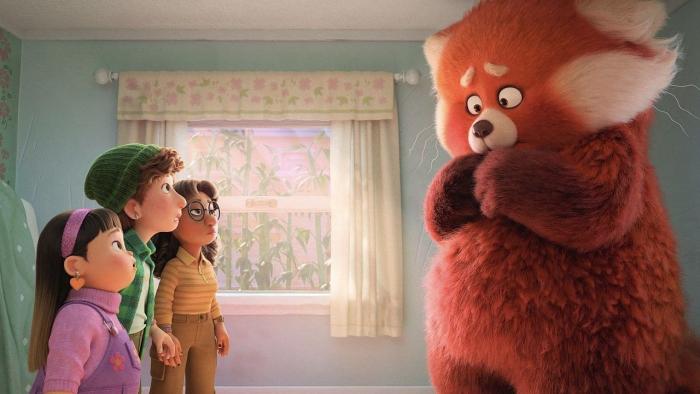
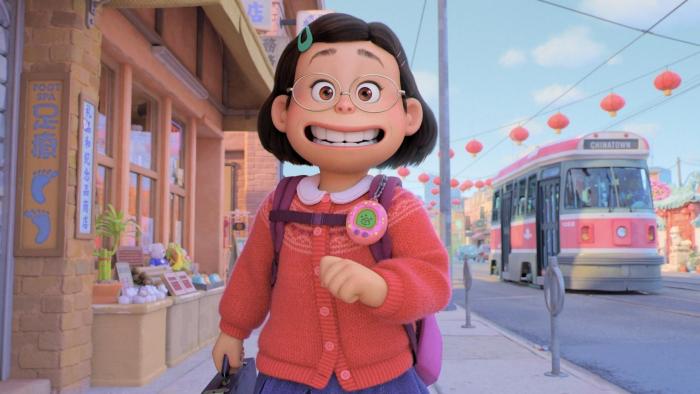
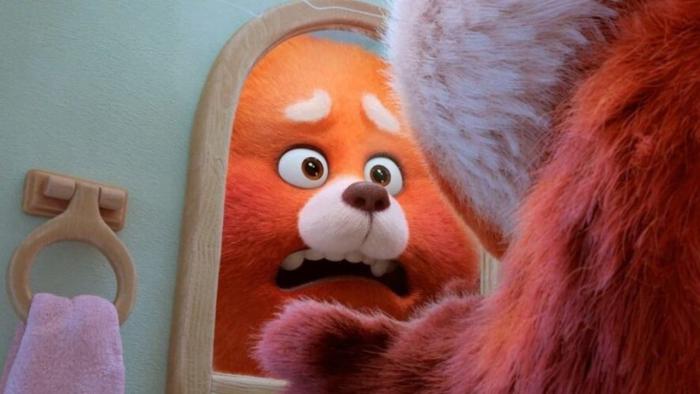
Set in Toronto circa 2003, Pixar's TURNING RED centers on 13-year-old Meilin "Mei" Lee (voiced by Rosalie Chiang), a rule-following middle schooler who's the only child of her overprotective parents, type-A Ming (Sandra Oh) and quiet Jin (Orion Lee), who run a Buddhist temple in the city's Chinatown. Mei and her three best friends -- Miriam (Ava Morse), Priya (Maitreyi Ramakrishnan), and Abby (Hyein Park) -- are infatuated with popular boy band 4Town and crush on a local teen who works at a convenience store. One morning, after an unsettling dream about both real and celebrity boys, Mei wakes up transformed into a literal red panda. She finds out that the metamorphosis is an ancestral rite of passage for the women in her family when they reach puberty, but that a lunar ceremony can confine the panda into an amulet. Since strong emotions can bring on the transformation, Mei must call upon all her meditation skills to resist the change until the ceremony can take place. That works for a while, until her friends convince her that changing into the panda could be fun -- and lucrative.
Is It Any Good?
Delightful, funny, unapologetically girl-centered, and a surprisingly touching allegory for adolescence, this is Pixar's most teen-friendly film. It's also a gift for anyone who remembers the onset of puberty, pining over musicians (in this case, a shout-out to millennials who crushed on O-Town, *NSYNC, Backstreet Boys, and the like), and struggling to balance meeting parental expectations with friendships and newfound interests. Chiang does a lovely job conveying Mei's emotional and physical changes -- how she genuinely wants to obey her parents, take care of their family temple, and be a good girl but also enjoys her BFFs, loud music, and, yes, boys (even if they are of the unattainable pop-heartthrob variety). And Oh, who's also Canadian, is ideally cast as Mei's mom, who's more complex than the fussy helicopter mom she initially seems to be. Although dad Jin is a kind and loving presence, Turning Red is at heart a story about mothers and daughters. Mei and Ming's dynamic is in some ways universal: the bittersweet and at times outright confrontational push-and-pull of surviving teen rebellion (whatever that looks like).
Visually, Turning Red, like all Pixar movies, is phenomenal. Director Domee Shi (who herself is Chinese Canadian and was 13 in 2002), is clearly drawing on her own lived experiences of Toronto, its Chinatown, and being a teen in the early '00s. The movie, like her short film Bao, is also an emotional reminder of the tender joy and turbulent angst of growing up -- particularly with a demanding but loving mother who has sky-high expectations. But audiences don't need to be Canadian, Chinese, women, girls, or millennials to relate to and enjoy this story, because its themes and central metaphor work for everyone who has or will experience the awkward excitement of transforming from child to teen. Like Inside Out or The Mitchells vs. the Machines, Turning Red is a standout addition to animated movies that capture the overwhelming feelings of coming-of-age.
Talk to Your Kids About ...
Families can talk about the theme of adolescence in Turning Red. How is puberty/coming-of-age a major part of the story? Do you think that makes the movie more relevant to tweens and teens than to younger kids?
Why do you think Mei always feels like she has to do what her parents, particularly her mother, wants? How does she learn to tell her parents the truth? Did you find the movie's family dynamics relatable?
How do Mei and other characters display courage, curiosity, empathy, and teamwork? Why are those important character strengths?
Did you relate to the movie's setting -- both the time (early 2000s) and the place (Canada)? Do you think that's necessary to appreciate the story's themes and messages?
Movie Details
- On DVD or streaming : May 3, 2022
- Cast : Rosalie Chiang , Sandra Oh , James Hong
- Director : Domee Shi
- Studios : Pixar Animation Studios , Disney+
- Genre : Family and Kids
- Topics : Animals ( Wild Animals ) , Fantasy ( Magic ) , Friendship , School ( Middle School )
- Character Strengths : Courage , Curiosity , Empathy , Self-control , Teamwork
- Run time : 100 minutes
- MPAA rating :
- MPAA explanation : thematic material, suggestive content and language
- Award : Common Sense Selection
- Last updated : April 29, 2026
Did we miss something on diversity?
Research shows a connection between kids' healthy self-esteem and positive portrayals in media. That's why we've added a new "Diverse Representations" section to our reviews that will be rolling out on an ongoing basis. You can help us help kids by
Suggest an Update
Common Sense Media's unbiased ratings are created by expert reviewers and aren't influenced by the product's creators or by any of our funders, affiliates, or partners.
See how we rate