

Goofy 1990s comedy has profanity, sex, transphobia.
Parents Need to Know
Why Age 13+?
Any Positive Content?
Parents Need to Know
Parents need to know that Ace Ventura: Pet Detective is a 1994 movie in which Jim Carrey plays an unconventional detective who specializes in cases involving animals. Carrey's character is larger than life, and the film is full of silly toilet humor—such as a character emerging from a bathroom soaking wet with shredded clothes, saying "do NOT go in there," and a character moving his buttocks to imply that it's talking. These jokes will amuse some viewers, but the gay and mental health jokes, hypersexualized women, and transphobia will turn off others. There's frequent sexual innuendo, and characters kiss, have sex beneath sheets, and have implied oral sex. A man is naked in the shower, but only his buttocks are shown. Strong language includes "s--t," "ass," "bitch," "damn," and "God" as an exclamation. Characters fight, fall into a shark-infested tank and are dragged through the water, fire guns, get kidnapped and tied up, and fall to their death from a balcony, with blood and a dead body briefly seen. A woman is stripped down to her underwear against her will. There's occasional drinking and smoking, and the Miami Dolphins sports team is featured heavily in the movie, alongside a few other brands.
To stay in the loop on more movies like this, you can sign up for weekly Family Movie Night emails
.
Language
some
Frequent profanity includes "rat's ass," "a--hole," "s--t," "bitch," "son of a bitch," "d--k," "bastard," "pissed," "hell," "goddamn," "damn," "d--k," and "s--tballs," as well as the exclamation "holy testicle Tuesday!" "God" is used as an exclamation. Middle finger gesture. Characters say others should "die of gonorrhea," and "blow me." Name-calling includes "loser," "idiot," "cry baby," "wimp," "ugly," "fatty," and "saddlebags."
Did you know you can flag iffy content?
Adjust limits for Language in your kid's entertainment guide.
A woman's cleavage is prominent in a scene. There's kissing, and she asks whether a man wants her to take off his pants, then bends down—oral sex is implied. Bed-rattling sex hidden under covers—characters moan and groan and are presumed naked beneath sheets, with shoulders and legs visible. Two people kiss passionately on top of a desk. Shot of a naked man in a shower, with his buttocks exposed and genitals covered by angles. Innuendo about a cavity search at security, penis size, "porkin'" someone's wife, being turned on, and having sex multiple times in a row. A woman appears in her underwear (see Violence & Scariness for details).
Did you know you can flag iffy content?
Adjust limits for Sex, Romance & Nudity in your kid's entertainment guide.
Violence is mostly slapstick and intended to be funny. Characters punch, bite, bang heads against walls, throw one another to the floor, and hit each other with objects. Some blood on faces. A character falls from his balcony and is killed; blood is seen on glass, and the dead body is briefly shown. Reference to suicide. People fall off cars and into shark-infested fish tanks, where one character is dragged through the water by a shark, resulting in torn clothing. People are threatened with guns, and shots are fired. A person repeatedly swings a baseball bat at a car and smashes the windows while a character is inside. A car flips and crashes. A character has a cloth put over his nose and mouth and falls unconscious, then is kidnapped and tied up. Pictures of a person are seen with knives and arrows stuck in the photo. A man is grabbed by the genitals while tied up. A character is kissed against their will, while another is publicly humiliated and forcefully stripped down to her underwear. A dolphin is kidnapped and presumed in danger.
Did you know you can flag iffy content?
Adjust limits for Violence & Scariness in your kid's entertainment guide.
The Miami Dolphins are featured prominently. Dan Marino, a former Dolphins quarterback, is shown filming a commercial for Isotoner gloves. Other brands shown or mentioned include Iams and 9Lives cat food, Marshall speakers, Nike, Kool-Aid, Gatorade, CNN, and Budweiser. The Mission: Impossible theme tune is played.
Drinking, Drugs & Smoking
a little
Drinking at a social function. Characters smoke cigarettes, including a person on the street who drinks from a bottle inside a paper bag and smokes a rolled-up cigarette that could be pot. Police mention drug deals.
Did you know you can flag iffy content?
Adjust limits for Drinking, Drugs & Smoking in your kid's entertainment guide.
Ace is kind and compassionate toward animals and works to save them from theft and abuse. He's eccentric, childish, and chaotic at times, but he proves himself smart and observant in solving crimes—even if his approaches are unconventional and frustrating to others. Melissa is unsure of Ace to start with and embarrassed by his outlandish behavior. But she gradually looks past appearances and understands that he has a good heart and is more intelligent and capable than he appears. Einhorn is a powerful, no-nonsense police lieutenant who tries to keep Ace out of her way. She initially seems to follow the rules but reveals ulterior motives.
Positive Messages
a little
It's important to look past first impressions. It's OK to do things your way, even if the people around you don't understand. But there aren't any consequences shown for breaking rules, and the film conveys that some people will go to any length to get revenge. Transphobic messages link being transgender with mental health struggles and "fooling" people.
Diverse Representations
Flagged for concern
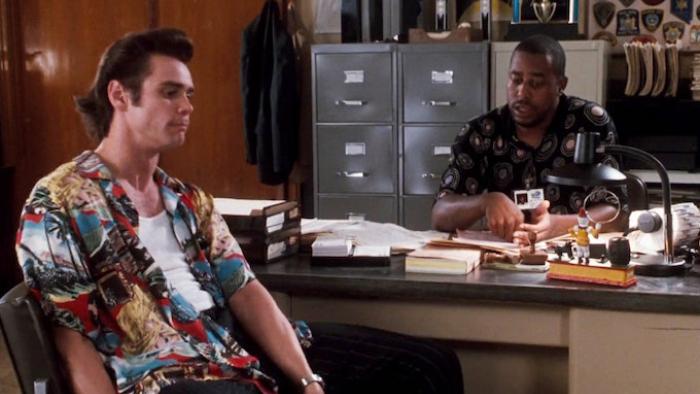
Rampant transphobia, plus misogyny, fat jokes, and homophobia, are all played for humor. A trans woman, who's played by a cisgender woman, is villainized in the plot. She's subjected to public humiliation to "prove" she's trans—stripped to her underwear to try to display her genitals. People react with disgust, throwing up, grimacing, and calling her a man—and a character who's kissed her cleans his teeth, takes a shower, and burns his clothes. The trans character is also described as having escaped from a "mental hospital" after suffering "paranoid, delusional psychosis." Another character pretends to have a mental illness in order to investigate the hospital and behaves stereotypically, looking unkempt, wearing a tutu, slurring their speech, and telling delusional stories. Women are often sexualized and end up in romantic entanglements with Ace. One woman is introduced with the camera slowly panning up from her ankles and up her legs; another is shown with her cleavage up close, billed as "Sexy Woman" in the credits. A slim female character is called "ugly," "fatty," and "saddlebags" as a joke. A gay joke involves a man thinking another is looking at his genitals at a urinal and smiling suggestively, then walking after him in a stereotypically effeminate way. Most characters are White, but one Black police officer, Emilio (African American actor Tone Loc), is portrayed positively as a good person who's also good at his job.
Parents say that this film is a mixed bag; many find it laugh-out-loud funny and a classic example of Jim Carrey's comedic genius, while others express concern over its crude humor and inappropriate content for children. Some argue that it reflects a different era of comedy that hasn't aged well, particularly due to its outdated jokes that some view as offensive and inappropriate for young viewers.
humor quality
appropriateness concerns
mixed reactions
outdated content
classic performance
comedy style
Summarized with AI
age 12+
Based on 74 kid reviews
Kids say that although this movie features a hilarious performance by Jim Carrey, it is packed with mature content that makes it unsuitable for younger audiences. Many reviewers highlight the crude humor, sexual references, and the overall inappropriate nature of the film, advising that it is best suited for older teenagers and adult viewers.
crude humor
mature content
inappropriate for kids
funny performance
outdated themes
Summarized with AI
What's the Story?
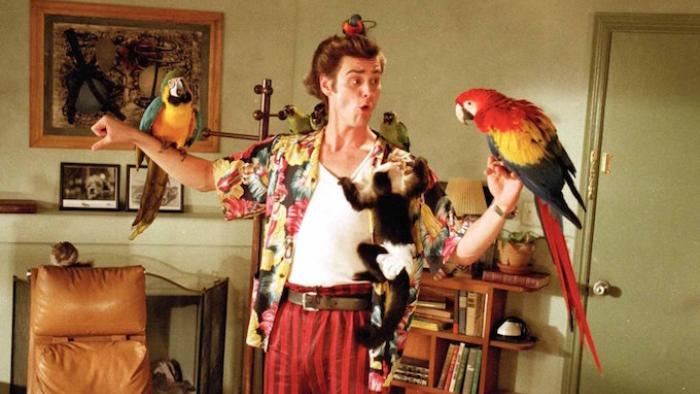
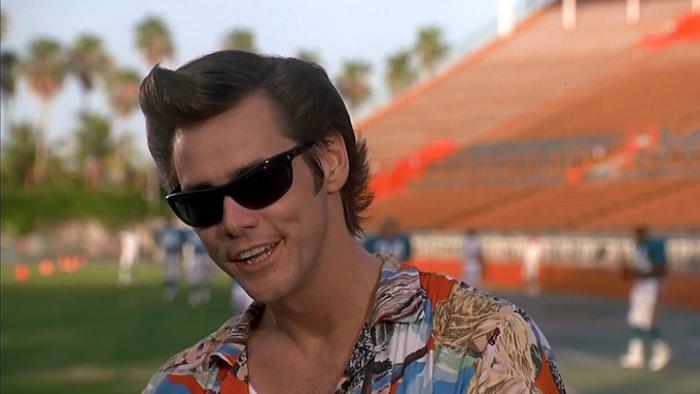
In ACE VENTURA: PET DETECTIVE, Miami Dolphins publicist Melissa (Courteney Cox) brings in pet detective Ace Ventura (Jim Carrey) for help when the team's mascot is kidnapped a week before the Super Bowl. Sporting a loud shirt and roller coaster hairdo, the wacky sleuth immediately begins an investigation, eventually unearthing a mystery involving a vengeful football player who once played for the Dolphins. Ace must race against the clock when he realizes that star player Dan Marino (as himself) is also in danger.
Without the comedy talents of Carrey, this popular 1990s movie wouldn't make much of an impact. At times, it feels like Ace Ventura: Pet Detective mostly revolves around Carrey's talent for contorting his face. On display, he mugs and writhes incessantly, shamelessly, for his audience. Director Tom Shadyac indulges his antics and butt-cheek ventriloquism, mindful not to put anything in the way—like too much of a plot—that might distract from his prize performer. Unfortunately, the talents of Sean Young and Cox are squandered in the meantime. Parents might be misled by the seemingly innocent movie title, and kids might be drawn to the idea of Carrey's silly antics, but be aware that there's strong language, toilet humor, and sexual content. Above all, its transgender and mental health stereotypes, gay jokes, and hypersexualized women overshadow an otherwise enjoyable, if very silly, comedy.
Talk to Your Kids About ...
Families can talk about humor in Ace Ventura: Pet Detective. What kind of humor does the movie use to make viewers laugh? How much of that is down to Carrey's unique acting? How does this movie compare to other Carrey comedies?
How is mental illness portrayed in the movie? What damaging stereotypes are present?
How does the movie treat its trangender character? How does it try to draw humor from Einhorn's gender—particularly toward the end? Can you think of other films that make fun of or villainize trans characters? Why is it important to discuss the impact of stereotypes with kids?
Research shows a connection between kids' healthy self-esteem and positive portrayals in media. That's why we've added a new "Diverse Representations" section to our reviews that will be rolling out on an ongoing basis. You can help us help kids by
Common Sense Media's unbiased ratings are created by expert reviewers and aren't influenced by the product's creators or by any of our funders, affiliates, or partners.