

Adam Sandler comedy has crude humor, language, stereotypes.
Parents Need to Know
Why Age 12+?
Any Positive Content?
Parents Need to Know
Parents need to know that Big Daddy is a 1999 comedy in which Adam Sandler plays an irresponsible man-child who "adopts" a young boy under false pretenses. While the movie's humor is on the whole typical goofy, obnoxious Sandler fare, with plenty of comedic pratfalls, jokes are made about people's age and body size, there's sexist language about women who work at Hooters, and offensive immigrant stereotypes also appear. A gay couple is seen in a loving relationship, but they're also clichéd, obsessed with how they look. Reference is made to foster parents and an orphanage. Characters pee against walls, a young boy vomits on-screen, and there are references to him wetting himself. Humor is mined from a 5-year-old saying things like, "Is that the guy with the old balls?" and "But I wipe my own ass," and adults frequently use variations of "s--t," "d--k," "hell," "a--hole," and "damn." There's an incredible amount of product placement, with characters repeatedly mentioning McDonald's, Hooters, Pepperidge Farm, Pepsi, and assorted Frito-Lay products. Characters drink alcohol, one is seen constantly drunk, and there are drug references.
To stay in the loop on more movies like this, you can sign up for weekly Family Movie Night emails
.
Drinking, Drugs & Smoking
a lot
A character references taking too many mushrooms in the 1970s. People drink beer and other alcohol, and a person at a bar is always seen drunk. A dad reminds his son of the time he found a bag of marijuana in his desk. An adult mentions smoking dope and drinking rum to a group of kids.
Did you know you can flag iffy content?
Adjust limits for Drinking, Drugs & Smoking in your kid's entertainment guide.
Frequent language includes "s--t," "bulls--t," "s--tload," "horses--t," "d--k," "hell," "ass," "a--hole," "piss," "crap," "damn," and exclamations of "good God." Middle-finger gesture. A child mimics an adult, saying "balls," "goddamn," "crap," and "a--holes." Insults include "cry baby," "moron," "stupid," "freaky," and "loser."
Did you know you can flag iffy content?
Adjust limits for Language in your kid's entertainment guide.
Comedic pratfalls. To make a child laugh, the lead character jumps in front of a moving vehicle and gets hit. A person bangs aggressively on a door, repeatedly bashes a phone receiver against a pay phone, and breaks into a man's house and demands items when he doesn't offer candy at Halloween. Mention of a cab running over a character's foot. Joking threats like "I'll smack you through the wall." A child vomits on-screen. Reference to a mom dying of cancer. Play wrestling results in a character strangled until they pass out, and they're briefly touched on the genitals without permission as a means of checking whether they're faking. A kid holds a slingshot, and piles of dead birds are later shown.
Did you know you can flag iffy content?
Adjust limits for Violence & Scariness in your kid's entertainment guide.
Sometimes people learn by making mistakes. Caring for others can help heal yourself. Taking responsibility doesn't mean you can't still have fun. However, bad behavior isn't always punished, and there aren't always consequences for your actions.
Positive Role Models
a little
Sonny is lazy and selfish at the start of the film. He finds amusement in making skaters fall in the park and other mean, childish pranks and is occasionally aggressive toward other adults. Gradually he learns to think of others more and to take responsibility. Layla is independent and hardworking. She's wary of allowing chaos into her life but shows empathy toward both young Julian and Sonny—recognizing his strengths along with his weaknesses.
Diverse Representations
Flagged for concern
Main characters are all White. Delivery guy Nazo mentions that he's not in the United States legally and is a stereotypically portrayed immigrant: He speaks broken English with a strong (unidentified) accent, watches the "Spice channel," and can't read—which a kid makes fun of. Another character says to "go ahead and get out" of the country if Nazo doesn't like spaghetti and meatballs. A character makes a reference to O.J. Simpson and points to a Black man, saying "this guy knows what I'm talking about." Constant jokes aimed at a woman who used to work at Hooters, belittling her in a sexist way and calling her "Big Boobs McGee." "Fights like a girl" is used as a putdown. Among the central friend group are a gay couple, who are seen to be in a loving relationship, though they also fall into stereotype as being obsessed with looks. A straight friend says he feels uncomfortable around the gay couple and moves a urinal over when peeing next to them. Central character Sonny, also straight, is more accepting and normalizes their relationship to him, saying they're the same people they were at high school. Jokes are made at the expense of a man's age: Characters call him "old man river," reference wrinkles and "old balls," and say "zip it or I'll break your hip." Fatphobic jokes: characters saying a larger man was with a different girl last time they saw him; maybe he ate her. A kid is encouraged to fake a stutter to garner sympathy from a woman. A person responds "gross" to a mention of eczema.
Parents say this movie is a hilarious and entertaining film with a mix of innuendo, foul language, and comedic moments, which many believe are manageable for older children. While some parents note the inappropriate parts, they appreciate the underlying messages about family and accepting responsibility.
hilarious film
inappropriate content
family messages
great for teens
manageable language
Summarized with AI
age 11+
Based on 66 kid reviews
Kids say this film is a mix of humor and heartwarming moments, but contains significant profanity and sexual jokes, making it more suitable for older kids and teens rather than younger ones. While many appreciate its comedic value and emotional themes, they also caution about the adult content that may not be appropriate for all audiences.
humor mixed with heart
significant profanity
suitable for older kids
emotional themes
caution for younger audiences
Summarized with AI
What's the Story?
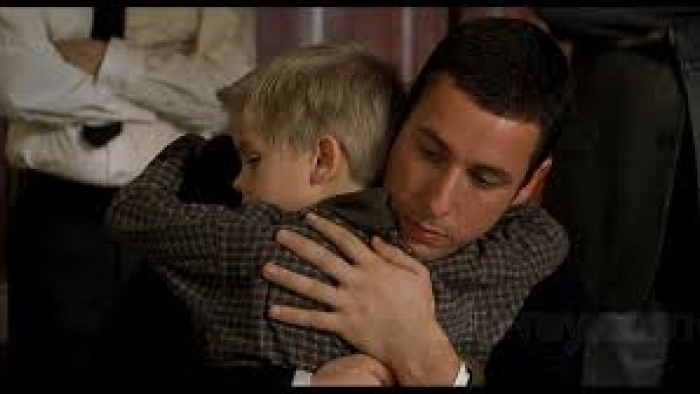
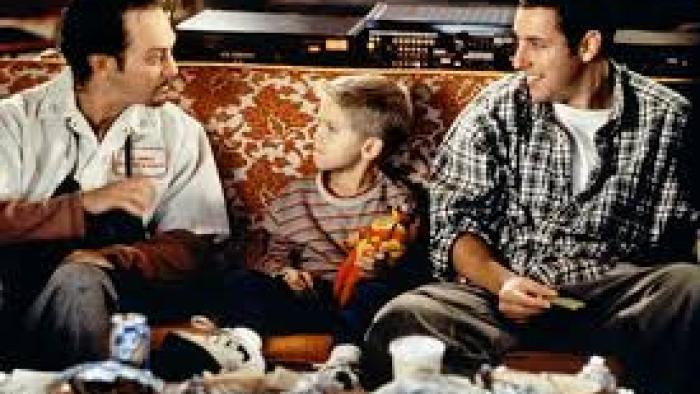
BIG DADDY centers on Sonny Koufax (Adam Sandler), a shiftless young man who's wasting his life, much to the chagrin of his parents, friends, and girlfriend. One day, 5-year-old Julian (played by twins Cole and Dylan Sprouse) is abandoned on Sonny's doorstep by mistake. Rather than place the boy in an orphanage, Sonny agrees to take care of him for a few days, thinking it will help win back his ex-girlfriend. At first, the two have fun behaving irresponsibly together, but gradually Sonny comes to love the boy and realizes that he wants to keep him. For that, he'll need to take some responsibility and take on the Department of Social Services as well.
This comedy has all the unavoidable elements of most Adam Sandler films: slapstick humor, gross jokes, bodily functions galore, spectacular pratfalls, and plenty of sexual innuendo. Yet Big Daddy is a welcome return to the sweetness and heart of The Wedding Singer after the numbing dopiness of The Waterboy, and the tasteless portions (about 90% of the film) are played in such a broad, obvious way that there's little risk teens will mistake this for acceptable behavior.
This isn't a profound movie, but teens may well enjoy it. Sandler has a light enough touch that the movie doesn't become sentimental or lose its sense of humor by adding some heart. Like the character he plays, Sandler is beginning to learn that you can be responsible and funny at the same time.
Talk to Your Kids About ...
Families can talk about the appeal of silly comedies such as Big Daddy. Where's the line between funny and offensive? What jokes or references, if any, do you think crossed that line?
How is product placement used in this movie? Why do some movies have what amounts to commercials shoehorned into the story? Do you think this is a problem? Does it affect how you see the brands, and does it encourage you to buy them?
Adam Sandler has a distinct style and personality that often defines his movies. Who are some other actors with their own signature styles, in both comedy and drama? How do they compare?
The movie makes jokes at the expense of others and includes stereotypes about immigrants, women, and a gay couple. Why is it important to consider the impact of seeing repeated clichés about people?
Research shows a connection between kids' healthy self-esteem and positive portrayals in media. That's why we've added a new "Diverse Representations" section to our reviews that will be rolling out on an ongoing basis. You can help us help kids by
Common Sense Media's unbiased ratings are created by expert reviewers and aren't influenced by the product's creators or by any of our funders, affiliates, or partners.