





Common Sense Media Review
Anonymous chat site created by teen is too risky for kids.
Parents Need to Know
Why Age 18+?
Any Positive Content?
Videos and Photos


Omegle

Parent and Kid Reviews
Based on 207 parent reviews
Based on 219 kid reviews
Kids say the website is entertaining for making random connections and potentially meeting new friends, but it is plagued by inappropriate content, including nudity and predatory behavior, making it unsafe for younger users. Many reviewers strongly advise against allowing children to access the site due to its high risk of exposure to sexual situations and dangerous individuals.
- unsafe for kids
- inappropriate content
- predatory behavior
- risk of exposure
 Summarized with AI
 Summarized with AI
Privacy Rating Warning
Privacy Rating
Our expert evaluators create our privacy ratings. The ratings are designed to help you understand how apps use your data for commercial purposes.
Pass
Meets our minimum requirements for privacy and security practices.
Warning
Does not meet our recommendations for privacy and security practices.
Fail
Does not have a privacy policy and should not be used.
Privacy Rating
Our expert evaluators create our privacy ratings. The ratings are designed to help you understand how apps use your data for commercial purposes.
Pass
Meets our minimum requirements for privacy and security practices.
Warning
Does not meet our recommendations for privacy and security practices.
Fail
Does not have a privacy policy and should not be used.
What's It About?
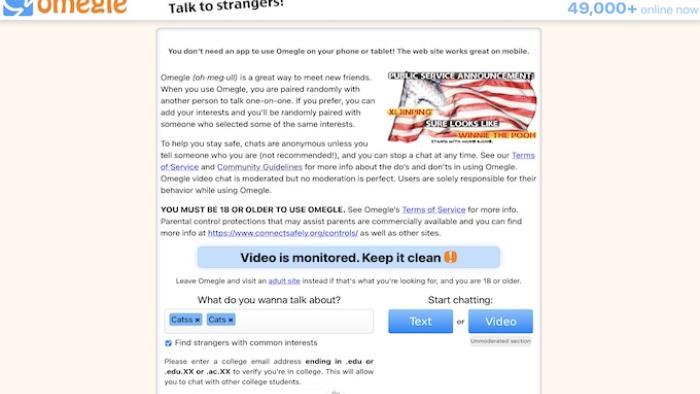
OMEGLE, pronounced oh-meg-ull, connects you anonymously with a person in a text or video chat. Users can enter a subject to be paired with someone who reportedly has a similar interest. If you enter an email that contains .edu or .ac to verify you're a student, you can chat with other college students. The site's homepage says video chats are monitored, but a note beneath the button you click on to enter one says "Unmoderated section," so their supervision level is somewhat unclear.
Is It Any Good?
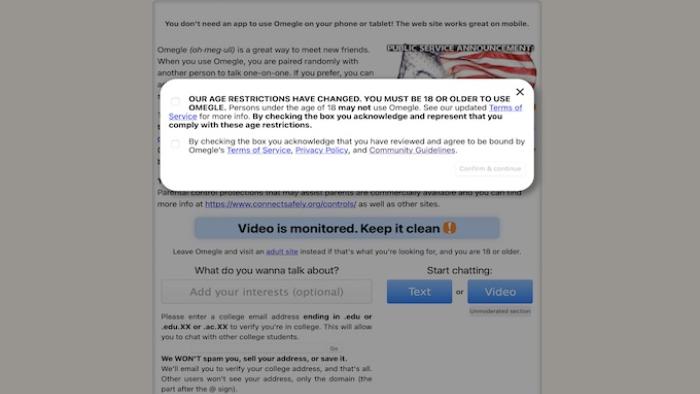
This site's barebones design doesn't offer much of a visual experience -- and there are just a couple of ways to connect to other people. Kids can text or video chat with other users on Omegle. College students can talk to each other if they submit an email address that ends in a variation of .edu or .ac to verify their status. Users can also enter a topic they're interested in and the site says it will connect them with someone else who shares that interest -- although it's unclear what kind of vetting and analysis occurs behind the scenes. The other site content primarily involves usage terms, some of which don't seem to be strictly enforced. Users are supposed to be 18 or older, for instance, but there's no real verification process. Text in the Community Guidelines section says threats, hateful conduct, nudity, and sexually explicit conduct are prohibited on the moderated portions of the site. It's unclear how strictly monitored they are, though -- particularly since text on the homepage says "no moderation is perfect." While the site contains a link to an external organization that offers information on parental control measures, Omegle doesn't offer any specific tools to help parents monitor kids' activity on the site.
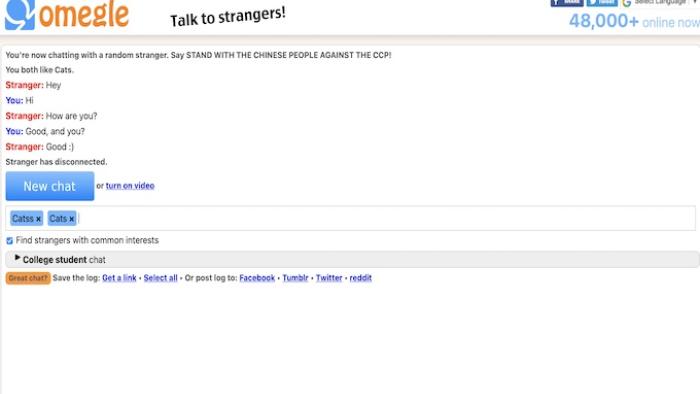
Chats can be -- and sometimes are -- friendly and kid-appropriate, with conversations surrounding topics like how each person is doing that day. Finding someone to video chat with can, at times, involve a wait. Some text chats end quickly, with the other user exiting moments after it starts. In theory, the site could be a way to have anonymous discussions with other people. Your identity isn't shown, and the other user is just listed as "Stranger" in written chats. The site description says chat users will remain unspecified "unless you tell someone who you are (not recommended!)" -- there's always a risk, though, that more detailed and potentially inappropriate information could be shared. Even more alarmingly, users are told if they're looking for an unmonitored experience, to visit an adult site -- and astonishingly, this site offers a link that leads to one. That aspect alone -- coupled with the other potential issues that could arise from using Omegle -- cancel out any communication skill strengthening benefits the site might otherwise be able to provide.
Talk to Your Kids About ...
Families can talk about the appropriateness of online chatting. Is there anything to be gained from talking to strangers on an uncensored chat site such as Omegle? What makes people say silly or ugly things to complete strangers? Read our tips on social networking.
What questions or comments can be a concern when you're chatting online? Discuss some red flags to watch out for -- and when kids should inform an adult.
Revisit Internet rules of safety, including: Never share your real name, age, phone number, or address with people you don't know.
Website Details
- Genre : Social Networking
- Pricing structure : Free
- Last updated : August 22, 2024
Did we miss something on diversity?
Research shows a connection between kids' healthy self-esteem and positive portrayals in media. That's why we've added a new "Diverse Representations" section to our reviews that will be rolling out on an ongoing basis. You can help us help kids by
Suggest an Update
Common Sense Media's unbiased ratings are created by expert reviewers and aren't influenced by the product's creators or by any of our funders, affiliates, or partners.
See how we rate